Even though we homeschool, we are in our final push towards the end of "school." Now, most of the homeschoolers I know consider that they homeschool year round. However, at least in our community, most of the organized classes and coops and sports and such are organized around the traditional school calendar of August/September through April/May/June. To some extent, that is just a practical economic decision--lots of facilities that host homeschoolers during the day when most students are in school can make a lot more money over the summer by running camps. But I think most of us enjoy the break from the scheduled events and having to prepare classes and events for multiple students beyond our own, and use the summer to just homeschool on our own and to do the typical summer things with vacations and swimming and the like. At least for us, summer is a good time to catch up on some of those things that we don't tend to do in groups--things like grammar and spelling and such.
But how do you know when you are done? When you are homeschooling, which means you basically have the same teacher in the same "school" for as many years as you homeschool?
In our case, our local homeschool group holds an annual student showcase on the first Saturday in June each year. Participating families get a table on which to display whatever they want to share about what they have been doing for the past 12 months. We invite family members, friends, neighbors, and the general public to come, which helps the community better understand all the things that homeschoolers do. In addition, our children get to hear from someone besides US about the quality and interesting nature of the work they have been doing for the past year. It is also an opportunity for the parents to assess all the things we have accomplished over the year (given that, overachievers that we tend to be, we tend to focus on all the things we HAVEN'T gotten around to doing), and that is a really good feeling.
Everyone does their showcase exhibits differently, but for the past several years, our family's focus has been on creating an electronic portfolio. We create a DVD of me interviewing my son about what he thinks are the highlights from the past year in the different disciplines---language arts, history, science, math, art, etc. The visuals behind his discussion of favorite or most valuable aspects of the past year's learning are photos or videos that relate to the project he is describing. For us, that is the best way to remember, re-evaluate, and record all the many things we've done over a year of homeschooling.
However, since he is now in middle school (hence the name of this blog, right?), I'm also starting to think about how to know when we are DONE done--as in, done with homeschooling and ready to move on to college or employment (or some combination of the two). There was a great article in the Washington Post about that yesterday in their education section. Entitled "How high school should really end," it describes one high school's graduation requirements beyond the typical standardized test. Seniors at this school must develop a portfolio that demonstrates (1) their plans for the coming year; (2) proof of their competency in the major subject areas; and (3) the positive impact they have had on the world. They must also present the results of a senior year project in which they show major learning through a significant project in the topic of their choosing.
I love this kind of thing as an end to our pre-collegiate education, and plan to do something like this when my son gets to an appropriate age and level. I think that any student who can pull off the above will be ready to take on the world, whether it is through college, work, travel, volunteerism, or the other paths that young adults follow.
Wednesday, May 11, 2011


Tuesday, May 10, 2011
Curriculum Resource: 20th Century American Music
The Library of Congress has launched a new curricular resource that I think can help us as we introduce our middle schoolers to the 20th century. Their new informational center, National Jukebox, is a digitized collection of musical recordings from the early 20th century. This is a great resource of all sorts of different early 20th century music--folk, classical, ragtime, popular, etc. There are also some speeches by such historical figures as William Jennings Bryant, Woodwrow Wilson, William Taft, Warren Harding, and even Teddy Roosevelt. It is a great way to give your middle schoolers a feel for the first part of the 20th century. And the Library intends to expand the collection, so there will probably be even more recordings as time goes on.
Monday, May 9, 2011
Discussing the Death of Osama bin Laden with Middle Schoolers
It can be difficult for us as parents and teachers to know how to approach emotional but potentially controversial current events, such as the recent raid and death of al-Qaeda leader Osama bin Laden, with our middle schoolers and teenagers. However, at least in the case of the Osama bin Laden case, the White House has some online resources to help us out.
On May 5, 2011, the White House sponsored a webinar on this topic for middle school and high school students. The person officiating the event was Ben Rhodes, Deputy Assistant to the President and Deputy National Security Advisor. Rhodes spent 10 minutes of the 30 minute webinar giving the White House perspective on the history and reasons why President Obama felt this course was necessary, and giving some fact about the attack itself. Rhodes then spent the next 20 minutes answering questions from the 1,700 inquiries sent him by middle and high school students.
I think Rhodes did a good job presenting the Administration's perspective in a pretty straight-forward way, and his responses answer a lot of questions that may be in your children's minds, even if they can't verbalize them. So I think this can be a useful resource in discussing this issue with them. While the webinar is obviously over, you can access the recordings at the Discovery Education website under the heading A Discussion on Osama bin Laden.
On May 5, 2011, the White House sponsored a webinar on this topic for middle school and high school students. The person officiating the event was Ben Rhodes, Deputy Assistant to the President and Deputy National Security Advisor. Rhodes spent 10 minutes of the 30 minute webinar giving the White House perspective on the history and reasons why President Obama felt this course was necessary, and giving some fact about the attack itself. Rhodes then spent the next 20 minutes answering questions from the 1,700 inquiries sent him by middle and high school students.
I think Rhodes did a good job presenting the Administration's perspective in a pretty straight-forward way, and his responses answer a lot of questions that may be in your children's minds, even if they can't verbalize them. So I think this can be a useful resource in discussing this issue with them. While the webinar is obviously over, you can access the recordings at the Discovery Education website under the heading A Discussion on Osama bin Laden.
Sunday, May 8, 2011
A Most Unique Mother's Day Gift
Happy Mother's Day to All! I'm sure many of the readers of this blog are mothers, so I hope you are being celebrated by your family as royally as you deserve to be! And, of course, I hope we are all honoring our own mothers and other women that have nurtured us to become who we are today.
My son and husband have been sweet to me today, so I've been having a lovely holiday. But I have to share one of the presents my son gave me for Mother's Day.
Several days ago, as I was heading out on a rare solo outing to my allergist or something, my son asked me if the shirts in the drawer still fit me. I wasn't paying that much attention because I was focused on getting together the stuff I needed to bring, but I assured him to leave them alone because they did fit. The thing is, my son likes to wear big, baggy clothes, so he is always trying to steal shirts from me, my husband, and even his size XXXXL grandfather. So I was mainly concerned that he wasn't going to abscond with one of the shirts that I like to wear.
What he did, however, was to take one of my shirts and decorate it with a Sharpie. Here is what he wrote first:

Below that, he wrote a huge mind map of some of his favorite topics:

I thought it was such a sweet, cute, and funny present. Definitely one of a kind--just like him!
He also did a small picture for me in art class, and bought a hand-made ceramic pot from one of the artists we visited on Friday on our First Friday gallery hop in Raleigh (which I've written about before).
We are going out soon for a meal at an Indian restaurant, which we've done for the past several Mother's Days. But this shirt, which expresses in such a comic but profound way his understanding of himself and his appreciation of our relationship and the joys and challenges it can present, will make this Mother's Day that will stick out for me. What greater gift could a mother get from a 12 year old boy than something like this?
My son and husband have been sweet to me today, so I've been having a lovely holiday. But I have to share one of the presents my son gave me for Mother's Day.
Several days ago, as I was heading out on a rare solo outing to my allergist or something, my son asked me if the shirts in the drawer still fit me. I wasn't paying that much attention because I was focused on getting together the stuff I needed to bring, but I assured him to leave them alone because they did fit. The thing is, my son likes to wear big, baggy clothes, so he is always trying to steal shirts from me, my husband, and even his size XXXXL grandfather. So I was mainly concerned that he wasn't going to abscond with one of the shirts that I like to wear.
What he did, however, was to take one of my shirts and decorate it with a Sharpie. Here is what he wrote first:
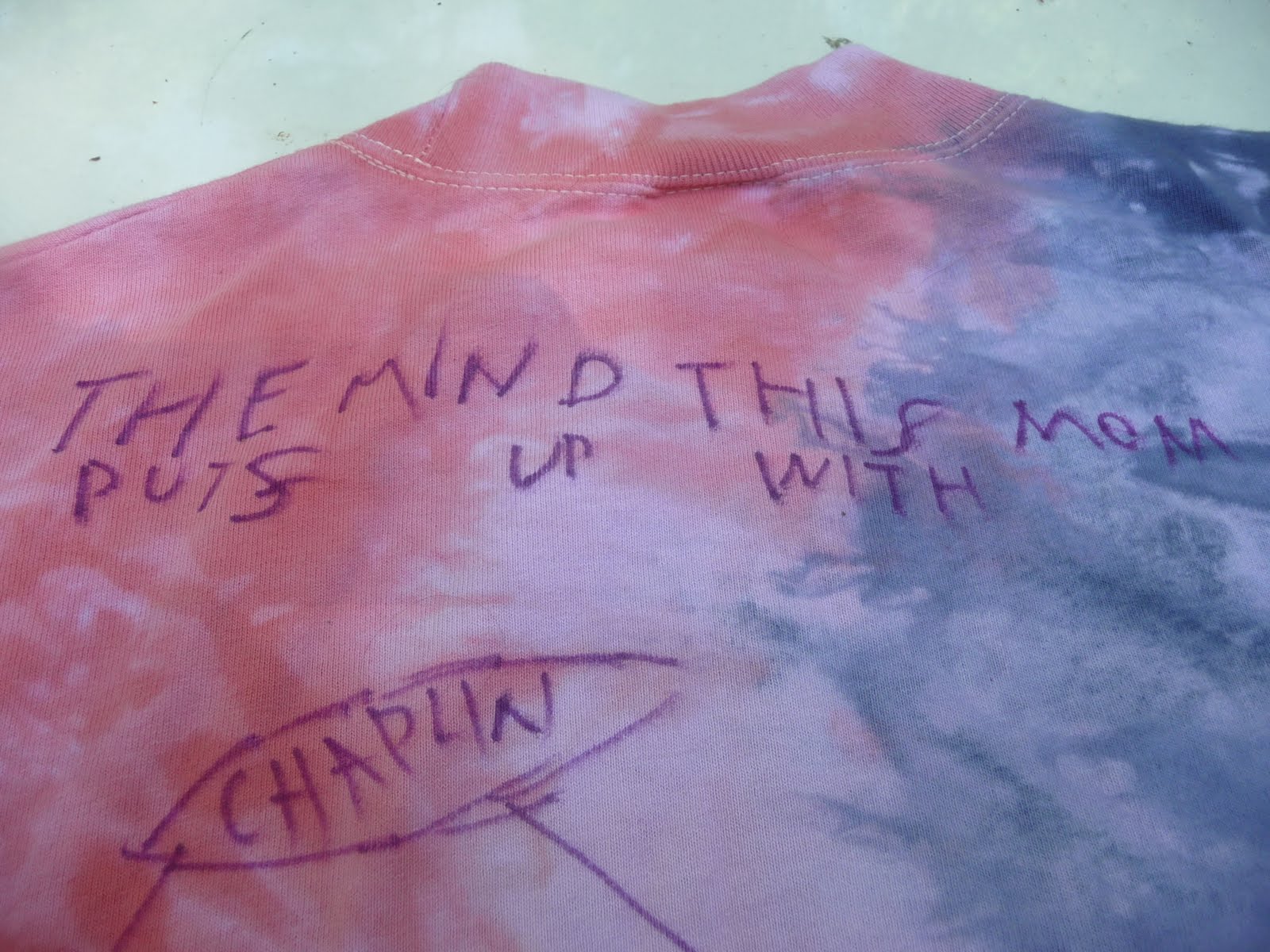
Below that, he wrote a huge mind map of some of his favorite topics:

I thought it was such a sweet, cute, and funny present. Definitely one of a kind--just like him!
He also did a small picture for me in art class, and bought a hand-made ceramic pot from one of the artists we visited on Friday on our First Friday gallery hop in Raleigh (which I've written about before).
We are going out soon for a meal at an Indian restaurant, which we've done for the past several Mother's Days. But this shirt, which expresses in such a comic but profound way his understanding of himself and his appreciation of our relationship and the joys and challenges it can present, will make this Mother's Day that will stick out for me. What greater gift could a mother get from a 12 year old boy than something like this?
Saturday, May 7, 2011
World Religions: Blackfoot Ritual
For last week's World Religion class, we had two guest teachers who study with a traditional Blackfoot Native American teacher through an organization known as Bear Spirit Medicine Lodge. We started with introductions, which included one teacher explaining the significance of the ceremonial gown she wore in honor of her birth tribe, who are the Algonquins in Canada.

They started by having the students make their own medicine bags as they explained the ideas about medicine in the Blackfoot tribe.

The BSML also gave them tobacco, beaver chew (a piece of wood that contains the mark of beaver teeth gnawing on the tree), and feathers and bead to put in or on their bags.

We then learned about the Blackfoot altar, including the ritual of calling in the four directions, the colors, seasons, plants, and animals associated with each direction, and other such things. The teachers also explained the Blackfoot ideas about how all things come from Creator, and thus are sacred, and how Man is in relationship with everything else on Earth (animate or inanimate), although we tend to forget that ancient truth.

For my favorite part of the class, however, we went outside and did a Blackfoot ceremony called the Blooming Tree ceremony. Each child had to select one particular tree--addressed as "Grandmother" by the Blackfoot as an ancient ancestor of the people. They prayed to the tree using ceremonial tobacco, which is itself considered to be a prayer by the Blackfoot. They had to give a tobacco offering and then ask one question for each of the four directions of their selected "grandmother," and then write down their responses.

The students had some beautiful answers for the simple, but profound, questions they were supposed to ask for each round. Here are some examples:
EAST: Who am I? The feelings of spirit; The power rooted with the earth's harmony; Love; The sun; Impartial
SOUTH: Where did I come from? The Indian tribe; Fire; The South; A place by which no man has come before; A place sacred to you
WEST: Why am I here? To grow and expand the line of people; To make a purpose; Love; To enjoy
NORTH: Where am I going? To the east; Where you feel is best; To a new life; A bird soaring through a beautiful blue sky

One student wrote this poetic summation of the experience:
I chose this tree because of all the different branches of life that had come before in its journey. I think of all the green leaves as good memories. I think of the dead leaves as memories that have been forgotten but not lost and journeying in the wind to find the place that suits them best.

They started by having the students make their own medicine bags as they explained the ideas about medicine in the Blackfoot tribe.

The BSML also gave them tobacco, beaver chew (a piece of wood that contains the mark of beaver teeth gnawing on the tree), and feathers and bead to put in or on their bags.

We then learned about the Blackfoot altar, including the ritual of calling in the four directions, the colors, seasons, plants, and animals associated with each direction, and other such things. The teachers also explained the Blackfoot ideas about how all things come from Creator, and thus are sacred, and how Man is in relationship with everything else on Earth (animate or inanimate), although we tend to forget that ancient truth.
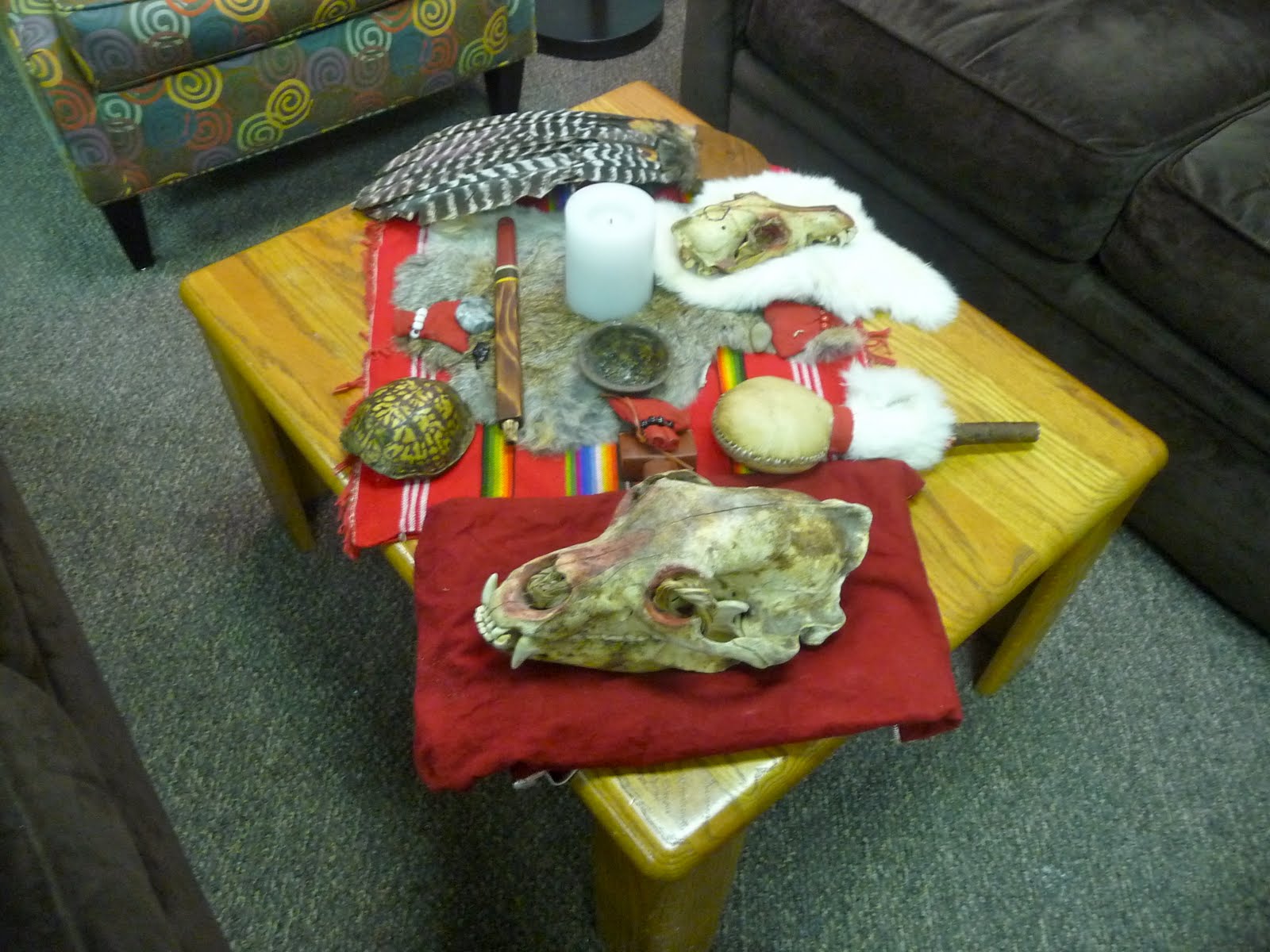
For my favorite part of the class, however, we went outside and did a Blackfoot ceremony called the Blooming Tree ceremony. Each child had to select one particular tree--addressed as "Grandmother" by the Blackfoot as an ancient ancestor of the people. They prayed to the tree using ceremonial tobacco, which is itself considered to be a prayer by the Blackfoot. They had to give a tobacco offering and then ask one question for each of the four directions of their selected "grandmother," and then write down their responses.

The students had some beautiful answers for the simple, but profound, questions they were supposed to ask for each round. Here are some examples:
EAST: Who am I? The feelings of spirit; The power rooted with the earth's harmony; Love; The sun; Impartial
SOUTH: Where did I come from? The Indian tribe; Fire; The South; A place by which no man has come before; A place sacred to you
WEST: Why am I here? To grow and expand the line of people; To make a purpose; Love; To enjoy
NORTH: Where am I going? To the east; Where you feel is best; To a new life; A bird soaring through a beautiful blue sky

One student wrote this poetic summation of the experience:
I chose this tree because of all the different branches of life that had come before in its journey. I think of all the green leaves as good memories. I think of the dead leaves as memories that have been forgotten but not lost and journeying in the wind to find the place that suits them best.
Friday, May 6, 2011
Curriculum Resource: Murderous Maths
I realized that I haven't written about one of our favorite math resources--the Murderous Maths series, developed in England and available in the US from Fun Books. The various books tackle different math topics, but in a humorous and applied way. Most of the problems are evolved from a situation or story discussed in the book. Plus they use that wonderful British sense of humor, which goes over really well with my son.
To give you some idea of how fun these books can be, here are some of the titles:
Murderous Maths: The Mean and Vulgar Bits (fractions, percentages, and averages)
Do You Feel Lucky? (probability)
The Phantom X (algebra)
Savage Shapes (geometry)
They are inexpensive paperback books with some cute illustrations, but pretty text dense. However, my son will just pick one up and read it for pleasure--which is saying something for the books, since math is not necessarily his favorite subject. They are not a traditional curriculum, but if your children like stories (and what child doesn't?), they are a nice supplement to the other math you may be doing.
To see a list of the math content in each book, click here.
To give you some idea of how fun these books can be, here are some of the titles:
Murderous Maths: The Mean and Vulgar Bits (fractions, percentages, and averages)
Do You Feel Lucky? (probability)
The Phantom X (algebra)
Savage Shapes (geometry)
They are inexpensive paperback books with some cute illustrations, but pretty text dense. However, my son will just pick one up and read it for pleasure--which is saying something for the books, since math is not necessarily his favorite subject. They are not a traditional curriculum, but if your children like stories (and what child doesn't?), they are a nice supplement to the other math you may be doing.
To see a list of the math content in each book, click here.
Thursday, May 5, 2011
Lesson Plan: 19th Century Japanese Game (Kai Awase)
In our 19th Century World History coop, we always have student presentations, then five stations prepared by the adults: timeline, maps, craft, game, and food (although, after typing that, I have to admit that the student preference is in exactly the opposite order). This week we were studying later 19th century Asian history---basically, what happened once Admiral Perry and company broke the Asian barriers to dealing with the West.
My assignment was to do a game. We are great fans of the book Heart of a Samurai, which I reviewed in a previous post, so I focused on Japan. My research showed that the Japanese played many games similar to our American card games, but they didn't use the paper cards like we did until well after they had been exposed to them by Portuguese traders. Rather, they used something that was prevalent in that island nation--they used shells. But in that Japanese way of only using things of beauty, they painted their shells and made them into incredible art pieces. These had been used for many centuries, but most of the example for which I could find photographs had been made during the 19th century, so they were still the rage at that time among the upper class Japanese.
I found that they played a game that was similar to our game of Concentration. Entitled Kai Awase (which the web tells me is based on "kai" meaning "shell" and "awase" meaning "joining" or "matching"), the point of this game is to find shells with the same picture inside. The shells have been painted in a beautiful Japanese style, often using gold plate and other expensive paints, with the inside/concave side having a scene from Japanese literature, poetry, or nature scenes. The shells are placed facing down, and players have to select the matching pair. However, this was particularly difficult because a full set of traditional kai awase shells contained 360 pairs of shells, all contained in a box called a "kaioke."
Based on this information, I tried making my own set of WAY faux kai awase. First, I bought some shells at Michaels (using my 40% discount coupon, of course). I covered the outside with origami paper, which I used Sparkle Mod Podge to adfix to the the shell. I know the Japanese scene was supposed to be inside the shell, but knowing the difficulties in adhering paper to shell, I was afraid I couldn't get exactly the same part of the origami paper to fit inside the shell, and thus might throw the students off in their match-seeking. However, although not the way the real items are, the students found them quite beautiful, which was a lesson I was trying to teach them about the Japanese culture.
On the inside, instead of a Japanese scene or a poem that I thought wouldn't be significant for our students, I stuck on pairs of kamons, or Japanese family crests. I found a website with copyright-free kamon images, and selected some animals symbols that I thought the students would enjoy. So the inside of the shells looked like this:
While a full set contained 720 shells, I'm afraid my set only had 16. However, that was sufficient to sustain the interest of our students, who played in groups of 3 or 4. I did make my version of a kaioki by adding some origami paper to a wooden cigar box that I had:
So, just like Concentration, the shells are placed kamon-side down, and students took turns picking two shells. If they matched, they got to keep them and score points from them. If they didn't match, they put them back, kamon-side down, and the next player got a chance to play.
I think the game worked out very well. While really nothing like their Japanese ancestors, my shells were shiny and pretty and the kids liked playing with them. They learned about kamons, and part of the game was trying to figure out what animals were displayed in the graphic images. At the end, I also gave them a chance to choose which of the images they would select for their family crest, and their choices were wide-ranging and somewhat revealing.
So if you are doing a unit on Japan, I recommend including something like this. I think it works because it contains some familiar elements--I think every middle schooler has played a matching game like this--but also illustrates some important aspects of Japanese culture in a way that is more interesting to kids than the usual lecture.
My assignment was to do a game. We are great fans of the book Heart of a Samurai, which I reviewed in a previous post, so I focused on Japan. My research showed that the Japanese played many games similar to our American card games, but they didn't use the paper cards like we did until well after they had been exposed to them by Portuguese traders. Rather, they used something that was prevalent in that island nation--they used shells. But in that Japanese way of only using things of beauty, they painted their shells and made them into incredible art pieces. These had been used for many centuries, but most of the example for which I could find photographs had been made during the 19th century, so they were still the rage at that time among the upper class Japanese.
I found that they played a game that was similar to our game of Concentration. Entitled Kai Awase (which the web tells me is based on "kai" meaning "shell" and "awase" meaning "joining" or "matching"), the point of this game is to find shells with the same picture inside. The shells have been painted in a beautiful Japanese style, often using gold plate and other expensive paints, with the inside/concave side having a scene from Japanese literature, poetry, or nature scenes. The shells are placed facing down, and players have to select the matching pair. However, this was particularly difficult because a full set of traditional kai awase shells contained 360 pairs of shells, all contained in a box called a "kaioke."
Based on this information, I tried making my own set of WAY faux kai awase. First, I bought some shells at Michaels (using my 40% discount coupon, of course). I covered the outside with origami paper, which I used Sparkle Mod Podge to adfix to the the shell. I know the Japanese scene was supposed to be inside the shell, but knowing the difficulties in adhering paper to shell, I was afraid I couldn't get exactly the same part of the origami paper to fit inside the shell, and thus might throw the students off in their match-seeking. However, although not the way the real items are, the students found them quite beautiful, which was a lesson I was trying to teach them about the Japanese culture.
 |
| Kai Awase shell |
On the inside, instead of a Japanese scene or a poem that I thought wouldn't be significant for our students, I stuck on pairs of kamons, or Japanese family crests. I found a website with copyright-free kamon images, and selected some animals symbols that I thought the students would enjoy. So the inside of the shells looked like this:
 |
| Butterfly Kamon on inside of Kai Awase shell |
While a full set contained 720 shells, I'm afraid my set only had 16. However, that was sufficient to sustain the interest of our students, who played in groups of 3 or 4. I did make my version of a kaioki by adding some origami paper to a wooden cigar box that I had:
 |
| Kaioke for Kai Awase game |
 |
| Kai Awase game pieces in Kaioke box |
So, just like Concentration, the shells are placed kamon-side down, and students took turns picking two shells. If they matched, they got to keep them and score points from them. If they didn't match, they put them back, kamon-side down, and the next player got a chance to play.
I think the game worked out very well. While really nothing like their Japanese ancestors, my shells were shiny and pretty and the kids liked playing with them. They learned about kamons, and part of the game was trying to figure out what animals were displayed in the graphic images. At the end, I also gave them a chance to choose which of the images they would select for their family crest, and their choices were wide-ranging and somewhat revealing.
So if you are doing a unit on Japan, I recommend including something like this. I think it works because it contains some familiar elements--I think every middle schooler has played a matching game like this--but also illustrates some important aspects of Japanese culture in a way that is more interesting to kids than the usual lecture.
Subscribe to:
Posts (Atom)