This week in our World Religion class, we are studying the story of Exodus, or the escape of the Jewish people from slavery in Egypt, following Moses in the desert for 40 years, and eventual entry into the Promised Land. The book we are using to tell this tale is Exodus by Brian Wildsmith. Brian Wildsmith is a book writer and illustrator from England who is not nearly as well known as he should be, given the gorgeous work that he does (he has won the English equivalent of the Caldecott for the best children's book artwork).
The text is clear and straight-forward and condenses an article book of the Old Testament/Torah in a concise, unbiased, and easily comprehensible way. While it can be used with elementary students, I think it is appropriate for middle schoolers as well. But what really sets this book apart is the artwork. The best word I can come up with to describe the illustrations is sumptuous! Wildsmith uses rich, almost glowing colors, and even gold leaf in some pages. His pictures are on a grand scale, capturing the grandeur of Egypt at the time of the Pharoahs and pyramids, and including depictions of hundreds or even thousands of people in the background. He includes, but doesn't dwell on, the less savory aspects of the story (such as the plagues and the killing of the first-born), and the drawings of that section won't upset more sensitive readers.
But one of the best parts of his take on this classic tale, at least to my mind, is how he shows the more fantastic components of the tale, such as the burning bush and God leading the people of Israel as a cloud or as a flame. I particularly like how he illustrates God in a symbolic, non-human way.
This is the kind of book that the illustrations can bring up as many discussion topics as the text. Like the Blockhead book, I think the wonderful art helps make it relevent to an older audience. Those who have heard the story before can find new information and objects of interest in the pictures, and those who aren't familiar with the tale aren't likely to forget it with such beautiful illustrations to support a visual memory of whole event.
Wednesday, October 6, 2010


Tuesday, October 5, 2010
Lesson Plan: Teaching Concrete Poetry
In "The Captain's Song" from the Gilbert and Sullivan comic opera, The HMS Pinafore, after the Captain has explained to his crew all his personal prohibitions that make him such an exemplary captain (things like never getting sick at sea, never swearing, etc.), they sing this refrain to each other:
Sailors: What, never?
Captain: No, never!
Sailors: What, never?
Captain: Well, hardly ever!
Like the Captain, one of my personal teaching policies is that I hardly ever give my students an assignment that I am not willing to do myself (or, at least, wasn't willing to do when I was at the same level of development) and/or haven't tried myself. I figure that if it's not interesting or valuable enough for me to do it, I shouldn't ask them to, and if I haven't tried it myself, how can I give them the best instruction on the matter? And while I've written a good bit of poetry in my time, I don't think I've ever written a concrete poem....which happens to be the topic I'm teaching this week.
So this past Sunday morning, I noticed something unusual as I was driving to our spiritual community, and so I ended up making a concrete poem out of the experience:

(OK, technically, this is actually a space poem, which shows movement through space related to the topic of the poem, rather than a concrete poem, which is supposed to take the shape of the subject. But we're covering both, so I think it still counts.)
I'm really glad I did it, because, like the I Spy poem, it is really much harder to do than it looks. Originally, the second stanza had varying numbers of words (from 9-11), and that just threw the entire composition off. So I had to find ways to express the same thing but with the same number of words while retaining the same syllable pattern. It was fun, but it ate up much more time than I expected (but, then, what doesn't?)
One thing that we've been doing in class is writing poetry after being inspired by music and/or art or photographs. And while the poem came from my experience (another thing we are discussing), the title was inspired by both. It is a twist on a Stephen Sondheim musical, Sunday in the Park with George, which is about the artist, Georges Seurat, as he paints his most famous painting, "A Sunday Afternoon on the Island of La Grande Jatte" (well, it's really about a lot more then that, since it is an examination on the nature of art and artists and relationships, but that's for another blog).
Anyway, were I a visual artist, or even somewhat proficient with Photoshop, I would attempt a picture of what I see in my mind when I think of this poem, which is Seurat's painting:
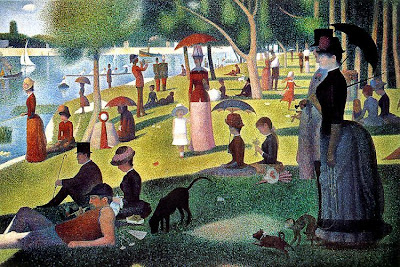
EXCEPT I would replace all the people with geese, and add a few contemporary touches, like one of them playing with a video game, and, of course, a pizza. Wouldn't that be a fantastic image?
But, the point is, I think it is really great if we can teach students to use all their senses when writing poetry. It's great to come up with wonderful words, but it is good for those words to connect with an actual experience, to be inspired by or contain some elements of music (in my case, it's "Putting It All Together" from Sunday in the Park with George), and to create a visual image (like my Seurat geese). Not every poem needs to have ALL of those, but they should have at least one of these to generate some substance beyond just the words. And try it yourself--see if your poem isn't more fun and/or more meaningful to you when it includes one or more of those elements.
For a related post, see A Concrete Poem on Catching Fire.
PS--My son wanted to be mentioned in this post, so I will just say that he read my draft and called it "a lovely poem," which I really appreciated hearing from him.
Sailors: What, never?
Captain: No, never!
Sailors: What, never?
Captain: Well, hardly ever!
Like the Captain, one of my personal teaching policies is that I hardly ever give my students an assignment that I am not willing to do myself (or, at least, wasn't willing to do when I was at the same level of development) and/or haven't tried myself. I figure that if it's not interesting or valuable enough for me to do it, I shouldn't ask them to, and if I haven't tried it myself, how can I give them the best instruction on the matter? And while I've written a good bit of poetry in my time, I don't think I've ever written a concrete poem....which happens to be the topic I'm teaching this week.
So this past Sunday morning, I noticed something unusual as I was driving to our spiritual community, and so I ended up making a concrete poem out of the experience:

(OK, technically, this is actually a space poem, which shows movement through space related to the topic of the poem, rather than a concrete poem, which is supposed to take the shape of the subject. But we're covering both, so I think it still counts.)
I'm really glad I did it, because, like the I Spy poem, it is really much harder to do than it looks. Originally, the second stanza had varying numbers of words (from 9-11), and that just threw the entire composition off. So I had to find ways to express the same thing but with the same number of words while retaining the same syllable pattern. It was fun, but it ate up much more time than I expected (but, then, what doesn't?)
One thing that we've been doing in class is writing poetry after being inspired by music and/or art or photographs. And while the poem came from my experience (another thing we are discussing), the title was inspired by both. It is a twist on a Stephen Sondheim musical, Sunday in the Park with George, which is about the artist, Georges Seurat, as he paints his most famous painting, "A Sunday Afternoon on the Island of La Grande Jatte" (well, it's really about a lot more then that, since it is an examination on the nature of art and artists and relationships, but that's for another blog).
Anyway, were I a visual artist, or even somewhat proficient with Photoshop, I would attempt a picture of what I see in my mind when I think of this poem, which is Seurat's painting:

EXCEPT I would replace all the people with geese, and add a few contemporary touches, like one of them playing with a video game, and, of course, a pizza. Wouldn't that be a fantastic image?
But, the point is, I think it is really great if we can teach students to use all their senses when writing poetry. It's great to come up with wonderful words, but it is good for those words to connect with an actual experience, to be inspired by or contain some elements of music (in my case, it's "Putting It All Together" from Sunday in the Park with George), and to create a visual image (like my Seurat geese). Not every poem needs to have ALL of those, but they should have at least one of these to generate some substance beyond just the words. And try it yourself--see if your poem isn't more fun and/or more meaningful to you when it includes one or more of those elements.
For a related post, see A Concrete Poem on Catching Fire.
PS--My son wanted to be mentioned in this post, so I will just say that he read my draft and called it "a lovely poem," which I really appreciated hearing from him.
Monday, October 4, 2010
Book Review: Blockhead: The Life of Fibonacci by Joseph D'Agnese
While I was searching the picture books section of my local library for a pornographic Eric Carle book (see this blog entry for more info), I found this wonderful book: Blockhead: The Life of Fibonacci by Joseph D'Agnese. Earlier this year, I met Joe and his partner (in writing, sometimes, but in life, always), Denise Kiernan, when they came to talk to our homeschool group about their fabulous book, Signing Their Lives Away: The Fame and Misfortune of the Men Who Signed the Declaration of Independence. (Not to get off topic, but this is a great resource for middle schoolers who are studying the American Revolution, because it has interesting child-oriented stories about all 56 signers of the Declaration--the famous and the forgotten. )
Anyway, I knew this book was coming out from talking to Joe, and knowing the quality of his work, I expected it to be good. And now that I've seen it, I'm happy to report that I was not disappointed. It does a great job of presenting the Fibonacci sequence of numbers in a way that can be easily understood by elementary students. But I think it is so well written, and the illustrations are so glorious, that I believe it is still appropriate to middle schoolers, especially those who are visual learners who have not yet learned to love the the numeric precision of mathematics.
The illustrator is John O'Brien, whom I don't know, but now would love to, because I think he did a great job. He managed to create beautiful and modern pictures that evoke the feeling of medieval wood carvings (at least to me). But most of all, he fills his pictures with all sorts of subtle depictions of Fibonacci numbers--Fibonacci curves and swirls, Fibonacci numbers captured in leaves, fruits, animals, and even landforms. This is part of the reason I think the book also works for older audiences; if they are already familiar with the Fibonacci sequence, they can be engaged in searching out the patterns drawn on each page.
However, there is another message in the book. In D'Agnese story (admittedly, a fiction based on scanty information about the real man), Fibonacci is called a "blockhead" by his contemporaries because he is so fixated by numbers--and so, doesn't see things like everyone else. The book also provides a supportive commentary to other children who are different, telling them to follow their passions, even if their peers don't understand them. As Fibonacci's mentor counsels him, after the child mathematician tells him that numbers are what make him happiest, "Then you should learn all you can about them. That way you will always be happy." What great advice that is for all of us!
My middle school son and I read it today, and at first he thought it was simple. But when he looked at it again, he found more and more layers to the pages. Then, when we went to spend time with my dear friend, math educator extraordinaire Miss Maria, we found ourselves searching out Fibonacci numbers in the rows of the pine cones we were throwing.
However, don't take my word for it. See the video that Denise created for the book at the book's website. Also, if you happen to use the book in a class or group setting, I can attest that Joe is a great speaker to students--engaging them at their level while still providing valuable content. Even if you don't have a budget to have him come speak in person, he does Skype visits for even nominal tax-deductible contributions to Heifer Internation (a charity that I have given to personally) as part of the Fibonacci Giving Project.
Sunday, October 3, 2010
World Religion: Experiencing Torah
We had a very special experience at our spiritual community today. We are developing a new World Religions class for the middle school youth, and that class had a presentation by Reverend Stacy Grove, an ordained interfaith minister who is one of the founders of Yavneh: A Jewish Renewal Community that meets in Christian churches and was featured in a recent article in the News and Observer. However, Rev. Grove also wears another hat; she runs a nonprofit called HeartSpace Spiritual Resources that, among other things, is the caretaker for a Torah scroll originally from the Czech Republic that is over 200 years old and survived the antipathy to such items by both the Nazis and the Communist Party. Rev. Grove traveled to Czechoslovakia and received this Torah in order to share it with a larger audience, particularly with non-Jewish communities, in an attempt to build a better understanding about the Jewish faith among the general public (since people practicing Judaism represent less than 1% of the world's population).
Rev. Grove spoke to the students about interfaith ministry, the story behind naming their new congregation Yavneh, and the Jewish Renewal movement. But the most riveting time was when she explained the traditions around reading Torah and read the very first passage from the scroll ("In the beginning...) in Hebrew.

At the conclusion of Sunday School and the adult service, many of the adults came in to hear Rev. Grove and see the Torah scroll for themselves. Rev. Grove gave a traditional Jewish blessing that is said to be especially powerful for those who are touch the scroll handles, which are called the Tree of Life. Apparently that was true, since several of the adults left that blessing with tears rolling down their cheeks.

Like I said, a very special and powerful experience. You could really feel a special energy coming from that ancient sacred text.
In this study of Judaism, I have been really struck by how much importance they put not just in the teachings of the Torah, but in Torah itself. They really revere the document itself, not just the wisdom it contains. That is a very interesting perspective to me, one that is very different from what I have traditionally experienced about various religions. In her talk, Rev. Grove said the whole business about Moses and the Jews wondering in the desert for 40 years was really about making them into a community (again, an interpretation I had never heard before). Maybe having a physical object like that helps build a strong community. Certainly that scroll itself has survived persecution, and was protected and hidden and fought for by community members against strong forces that were trying to destroy Torahs. I had a similar experience this summer when I took my son to the National Archives to see the original versions of the Declaration of Independence and the Constitution. There is just a special aura about these original documents. Maybe we as humans need these physical manifestations of the ideas and concepts that are most important to our lives. I need to consider that more.
Of course, since I don't believe in coincidences, I'm sure it was no accident that this took place immediately after Banned Books Week. They have both given me a lot to think about--and especially to appreciate.
Rev. Grove spoke to the students about interfaith ministry, the story behind naming their new congregation Yavneh, and the Jewish Renewal movement. But the most riveting time was when she explained the traditions around reading Torah and read the very first passage from the scroll ("In the beginning...) in Hebrew.

At the conclusion of Sunday School and the adult service, many of the adults came in to hear Rev. Grove and see the Torah scroll for themselves. Rev. Grove gave a traditional Jewish blessing that is said to be especially powerful for those who are touch the scroll handles, which are called the Tree of Life. Apparently that was true, since several of the adults left that blessing with tears rolling down their cheeks.

Like I said, a very special and powerful experience. You could really feel a special energy coming from that ancient sacred text.
In this study of Judaism, I have been really struck by how much importance they put not just in the teachings of the Torah, but in Torah itself. They really revere the document itself, not just the wisdom it contains. That is a very interesting perspective to me, one that is very different from what I have traditionally experienced about various religions. In her talk, Rev. Grove said the whole business about Moses and the Jews wondering in the desert for 40 years was really about making them into a community (again, an interpretation I had never heard before). Maybe having a physical object like that helps build a strong community. Certainly that scroll itself has survived persecution, and was protected and hidden and fought for by community members against strong forces that were trying to destroy Torahs. I had a similar experience this summer when I took my son to the National Archives to see the original versions of the Declaration of Independence and the Constitution. There is just a special aura about these original documents. Maybe we as humans need these physical manifestations of the ideas and concepts that are most important to our lives. I need to consider that more.
Of course, since I don't believe in coincidences, I'm sure it was no accident that this took place immediately after Banned Books Week. They have both given me a lot to think about--and especially to appreciate.
Saturday, October 2, 2010
Art Museum Seeking Teacher Input
I had a great experience today. I got to be part of a brainstorming session for teachers sponsored by the North Carolina Museum of Art. As I assume at least the locals (Raleigh-area) know, the NC Museum of Art opened a new state-of-the-art building this spring. New technology allows the walls to bring in sunlight without damaging the art, which to me, at least, totally transforms my experience of viewing the art. I love the new building (although my son complains because the building is all rectangular...).
Anyway, with the new building, the Museum is changing lots of other things as well. So they were sponsoring this session to get input about redesigning their teacher education/support systems, workshops, and tours, both online and in person. Because their charge is to share resources with the entire state, not just those of us who are lucky enough to live close to the museum, they are particularly looking into ways to do more teacher education online (although they continue to work on teacher workshops and tours and such).
The staff said that in the past, they had tended to try to tie museum resource to particular curricula---so, for example, NCMA painting related to social studies, to science, etc. They reported that, frankly, that hadn't worked too well. So they are looking into new ways to organize and present their teacher resources.
They had us do a few exercises involving NCMA paintings that relate to curricula, and then revealed their new approach. They are working towards organizing resources more along the lines of concepts, such as conflict, perspective, patterns, interdependence, environment, technology, etc. They are thinking these concepts are a better way to approach the collect because they involved multiple disciplines (since art, math, social studies, language arts, etc. might all talk about the concept of pattern or environment). They also plan to have things like tags to align resources or lessons with specific educational disciplines or topics, but think the conceptual approach will better foster more curriculum integration among more classes.
Anyway, it was a fun session, but even more, it was a great opportunity for teachers to have a say into how a major state resource is planning to serve them better. They were very open to suggestions, and asked us to email them if we had more ideas or concerns after some time considering this approach.
So if anyone has any feedback about this idea about organizing the educational resources along the lines of concept, please let me know and I'll will share them with the organizers. I know they would really appreciate your opinions about how the Museum can best serve educators of whatever variety (public, private, homeschool) or level (preschool-college).
Also, just in the name of full disclosure, I also attended a similar session at the Nasher Museum of Art at Duke University this summer. It is wonderful to have these great resources available to us, and even more wonderful that they are reaching out to us and trying to find out how they can best serve us.
Anyway, with the new building, the Museum is changing lots of other things as well. So they were sponsoring this session to get input about redesigning their teacher education/support systems, workshops, and tours, both online and in person. Because their charge is to share resources with the entire state, not just those of us who are lucky enough to live close to the museum, they are particularly looking into ways to do more teacher education online (although they continue to work on teacher workshops and tours and such).
The staff said that in the past, they had tended to try to tie museum resource to particular curricula---so, for example, NCMA painting related to social studies, to science, etc. They reported that, frankly, that hadn't worked too well. So they are looking into new ways to organize and present their teacher resources.
They had us do a few exercises involving NCMA paintings that relate to curricula, and then revealed their new approach. They are working towards organizing resources more along the lines of concepts, such as conflict, perspective, patterns, interdependence, environment, technology, etc. They are thinking these concepts are a better way to approach the collect because they involved multiple disciplines (since art, math, social studies, language arts, etc. might all talk about the concept of pattern or environment). They also plan to have things like tags to align resources or lessons with specific educational disciplines or topics, but think the conceptual approach will better foster more curriculum integration among more classes.
Anyway, it was a fun session, but even more, it was a great opportunity for teachers to have a say into how a major state resource is planning to serve them better. They were very open to suggestions, and asked us to email them if we had more ideas or concerns after some time considering this approach.
So if anyone has any feedback about this idea about organizing the educational resources along the lines of concept, please let me know and I'll will share them with the organizers. I know they would really appreciate your opinions about how the Museum can best serve educators of whatever variety (public, private, homeschool) or level (preschool-college).
Also, just in the name of full disclosure, I also attended a similar session at the Nasher Museum of Art at Duke University this summer. It is wonderful to have these great resources available to us, and even more wonderful that they are reaching out to us and trying to find out how they can best serve us.
Friday, October 1, 2010
Celebrating the Freedom To Read
Today one of our local libraries had "Freedom To Read" events all day long in honor of Banned Books Week, a program spearheaded by the American Library Association to fight censorship of books in public libraries. At our local event, people from the community read passages from their favorite books that have been challenged or banned from either school or community libraries.
This was an eye-opening event for me because while we hear occasionally about such things as families trying to remove the Harry Potter series from libraries because it promotes the occult, I thought that we had grown beyond quite so much focus on censorship. However, the BBW produced a booklet of the books that, in 2009-2010, people had challenged and, in many cases, have been successful in either restricting or banning completely from schools and libraries, and I was amazed to see how many books are still being disputed. Some I'm not familiar with, but from the title alone, I could see how some people might have concerns (although they all seemed to be appropriate to me for an audience above the elementary level). Some, however, I found unbelievable. In Texas, one father objects to the Newbery Honors award winner The Egypt Game because it features "evil gods and black magic." While libraries across the country are doing special programs in honor of the 50th anniversary of To Kill a Mockingbird, a school in Ontario removed the book because it uses "the N word." A school in California has pulled The Merriam-Webster Collegiate Dictionary because it contains definitions of sexual activities. But the worst of all to my mind--the schools in Virginia that agreed to drop The Diary of Anne Frank from their curriculum because it contained "sexual material and homosexual themes."
The library also had a book of the 100 most-frequently challenged, restricted, or banned books of all times. Many of them I had heard complaints about, such as Catcher in the Rye, Fahrenheit 451, and the like. But some of the most popular middle school writers and books were on the list, including Newbery winner A Wrinkle in Time ("can confuse children about good and evil and lists Jesus Christ in the same category as premier artists, philosophers, and scientists"), Junie B. Jones ("sassy behavior"), and Are You There, God? It's Me, Margaret ("frank treatment of adolescent sexuality and religion"). More predictably, the Twilight series also made the list for its sexual content. The one that really knocked me for a loop, though, was the attempt to ban Draw Me a Star by Eric Carle. ERIC CARLE? He of the torn painted tissue paper? And the reason listed for the challenge was "sexual content and nude illustration." ERIC CARLE??? It took me two libraries, but I finally tracked down a copy of the book. There is one illustration of two naked people by a tree that I assume are supposed to be Adam and Eve, although the book does not say that. And there are vague suggestions of male and female anatomy, although I doubt it is anything that the target audience (which should be around 3-6, given the simplicity of the language and story) would notice.
Anyway, it was all a great reminder for me of how much I take our libraries, our relatively open-minded community, and our American freedoms of expression for granted.
If you want to check out the list of book challenges over the past year for yourself, visit the ALA site.
This was an eye-opening event for me because while we hear occasionally about such things as families trying to remove the Harry Potter series from libraries because it promotes the occult, I thought that we had grown beyond quite so much focus on censorship. However, the BBW produced a booklet of the books that, in 2009-2010, people had challenged and, in many cases, have been successful in either restricting or banning completely from schools and libraries, and I was amazed to see how many books are still being disputed. Some I'm not familiar with, but from the title alone, I could see how some people might have concerns (although they all seemed to be appropriate to me for an audience above the elementary level). Some, however, I found unbelievable. In Texas, one father objects to the Newbery Honors award winner The Egypt Game because it features "evil gods and black magic." While libraries across the country are doing special programs in honor of the 50th anniversary of To Kill a Mockingbird, a school in Ontario removed the book because it uses "the N word." A school in California has pulled The Merriam-Webster Collegiate Dictionary because it contains definitions of sexual activities. But the worst of all to my mind--the schools in Virginia that agreed to drop The Diary of Anne Frank from their curriculum because it contained "sexual material and homosexual themes."
The library also had a book of the 100 most-frequently challenged, restricted, or banned books of all times. Many of them I had heard complaints about, such as Catcher in the Rye, Fahrenheit 451, and the like. But some of the most popular middle school writers and books were on the list, including Newbery winner A Wrinkle in Time ("can confuse children about good and evil and lists Jesus Christ in the same category as premier artists, philosophers, and scientists"), Junie B. Jones ("sassy behavior"), and Are You There, God? It's Me, Margaret ("frank treatment of adolescent sexuality and religion"). More predictably, the Twilight series also made the list for its sexual content. The one that really knocked me for a loop, though, was the attempt to ban Draw Me a Star by Eric Carle. ERIC CARLE? He of the torn painted tissue paper? And the reason listed for the challenge was "sexual content and nude illustration." ERIC CARLE??? It took me two libraries, but I finally tracked down a copy of the book. There is one illustration of two naked people by a tree that I assume are supposed to be Adam and Eve, although the book does not say that. And there are vague suggestions of male and female anatomy, although I doubt it is anything that the target audience (which should be around 3-6, given the simplicity of the language and story) would notice.
Anyway, it was all a great reminder for me of how much I take our libraries, our relatively open-minded community, and our American freedoms of expression for granted.
If you want to check out the list of book challenges over the past year for yourself, visit the ALA site.
Thursday, September 30, 2010
Curriculum Resource: The Timeline of Jewish History
If there are others who are studying Judaism as part of a World Religions course, I found a website that is so helpful to me in getting myself straight about the different patriarchs and historical stories about the Jewish people. The Timeline of Jewish History traces the entire story of Jewish development, from the time of Adam and Eve (Jewish Year 1, or Civil Year 3760 BCE) down through the establishment of the state of Israel in 1948 BCE (Jewish Year 5708). It is so helpful to see who came before whom, and who descended from Abraham, and when the events occurred that are remembered today through holidays like Purim and Hanukkah.
This timeline comes from the website Akhlah, The Jewish Children's Learning Network. It is only one of many wonderful resources for people who are learning about Judaism. It has sections about major Jewish figures, holidays, prayers and blessings, lesson about Hebrew, and great introductory material to many topics in Judaism. I highly recommend it!
This timeline comes from the website Akhlah, The Jewish Children's Learning Network. It is only one of many wonderful resources for people who are learning about Judaism. It has sections about major Jewish figures, holidays, prayers and blessings, lesson about Hebrew, and great introductory material to many topics in Judaism. I highly recommend it!
Subscribe to:
Posts (Atom)