Tonight I went to a different type of party--it was a celebration of the life of American mathematician Martin Gardner, who died earlier this year at the age of 95. Martin Gardner is considered to be the father of recreational math, because he focused on exposing people to fun mathematics through games, puzzles, toys, and such. He wrote math columns in popular magazines, such as Jack and Jill and Scientific America, that first brought broad exposure to such math topics as fractals, tangrams, M. C. Escher, and other math-related games and puzzles.
The evening was called "Gathering for Gardner: Celebration of Mind," and there were over 60 parties of this type taking place around the world on this date. All the parties had a common theme: to honor the life's work of this extraordinary man by having people come together to play with math.
Our particular gathering was focused on the intersection of math and art. It was organized and run by two women who are very important to our family: Maria Droujkova of Natural Math, who is a great friend and works with my son to find his passion for mathematics, and Jenny Eggleston of Egg in Nest studio, who is a wonderful artist and an intuitive and effective art coach/teacher for my son. Both women have a great talent for understanding each student with his or her unique talents and challenges, and individualizing their instruction to provide each one with just the assistance s/he needs. So spending an evening with them, and some other friends who are homeschooling parents and teen, is going to be valuable, regardless of what we do.
We began by making 3-D sculptures out of drinking straws and/or pipe cleaners. Then we admired some fantastic origami, art, and artistic videos related to numbers in nature. But the bulk of the evening was spent playing "The Glass Bead Game," which was inspired by Herman Hesse's book of the same name. We covered a long table with a roll of white paper and drew around small plates to form our first set of glass beads. We were given a question to answer visually, and we drew our answers inside our own beads. Then we found someone else's bead that inspired us, drew a new bead close to it, and drew a picture that "rhymed" visually with the first bead (as well as drawing a line of connection between the two). We did this for a couple of rounds, and soon the paper was filled with all sorts of visualizations related to math, life, death, the universe, and Jackie Chan (that last one was my fault...I kind of got off track a bit).
Anyway, it was a fun and thought-provoking night and a great way to recognize a great mathematician.
Thursday, October 21, 2010


Wednesday, October 20, 2010
Next 4th of July, Drink a Toast to Our Friends, the Mosquitoes
I know that I'm a history buff, so what excites me may not excite everyone else. But I found another article in the Washington Post this week--and not even in the education section--that I just have to recommend to everyone.
As I wrote in one of my "The Social Network" blogs recently, I think US history, particularly about American History, is too focused on the "Great Man and Woman" approach to history. In this article, Georgetown University History Professor J.R. McNeill suggests that we didn't win our independence at the Battle of Yorktown due to the brilliance of US General George Washington, or even from the failures of British General Charles Cornwallis, but from the assistance of our allies. Oh, of course, the French troops, you might be thinking....but that is not what McNeill is referring to. The Spanish? you might ask. But no. Our allies, that invincible force that tipped the scales to the side of the US forces for the victory were, in fact.......mosquitoes.
Of course, it was not mosquitoes, per se, that made the difference. Rather, it was the malaria infection that the mosquitoes transmitted. Malaria is one of the most deadly diseases in the world, injecting a parasite into the liver and blood cells that can lead to fever, headaches, hallucinations, coma, and death. Back then, they had no idea that it was transmitted by mosquitoes, and so took no preventative measures against their attackers (other than for comfort reasons). They also had no treatment for the disease--or, at least, no treatment that wasn't ineffective at best (eating cobwebs or spiders to tearing out one's hair) and counter-productive at worse (such as draining up to 10% of the blood supply or drinking heavy metals such as mercury).
Of course, it was not as though the mosquitoes that thrived in tidewater Virginia and the Carolinas were partial to the US side and attacked only the British. Actually, they were pretty equinimical in terms of biting both sides. The thing is, for most of the American troops, they had been bitten before. Malaria was a terrible force in the American population, having killed many thousands of people, particularly children. But those who had been exposed to the disease and survived (usually multiple times) carried a resistance with them for life. So while malaria took a toll on the American troops, most American soldiers had already developed some natural protection against the disease.
However, the British and German (or Hessian) troops had not been exposed to this infection. Therefore, it ran rampant through its ranks, particularly because Cornwallis came to Yorktown after over a year in malaria-ridden South Carolina. Actually, Cornwallis was headed towards higher, less mosquito-ridden ground when he was ordered to return to tidewater Virginia by his superior officer in New York. By the time of the Yorktown battle, Cornwallis stated that over half of his men were too sick to serve any effective purpose in fighting the US and French troops (who had arrived only about a month earlier--not long enough for the effects of malaria to have such a dramatic effect on their numbers).
And so it was that a force that was considered to be militarily superior had to surrender to the Americans--all due to those pesky little mosquitoes.
I just love this story. But I think it illustrates a larger issue about teaching history. Although I didn't learn history with any environmental factors considered, I think it is critical to include environmental education in our instruction for our children. This is only one example of the fact that we ignore the environment at our own peril.
Tuesday, October 19, 2010
The Great Raleigh Trolley Adventure
This has really been a fabulous week, because I got to have another special experience this evening. The keynote speaker at our summer conference on Teaching Your Middle Schooler, Dr. Candy Beal from NC State University who specializes in middle school education, invited me to join her graduate students on an event she does every year, The Great Raleigh Trolley Adventure.
Those who attended the conference know what a great speaker Candy Beal is. Tonight I got to see her more in her role as university professor, demonstrating to her students what it is to be an exceptional teacher.
The contents of The Great Raleigh Trolley Adventure is around 20 people in a trolley-style bus traveling all around downtown Raleigh and learning about the history of various sites in the city. The context of the tour, however, is Candy's belief that teachers need to learn about and be actively visible in the community that they end up teaching in to help demonstrate their commitment to and credibility within that community. Another contextual aspect to the trip is Candy's assertion that middle schoolers are particularly concerned about two questions:
I think those are really important points for us all to keep in mind, whether we are parents, paid teachers, middle school volunteers, or homeschoolers. Another thing that I appreciated about participating in this activity was Candy modeling the importance of teacher as storyteller. As we zipped around the city in our colorful trolley, Candy was telling us even more colorful stories about the places we were seeing and the people who created, inhabited, and then left them. It was great evidence for me in my belief that history is not about facts and figures and dates and such, but rather a narrative about events that have happened in our past and why they matter. But, then, that might have been a factor of a theory I heard in another educational podcast I listened to today: You don't believe what you see, you see what you believe.
Anyway, it was a fun evening. I was actually familiar with most of the major historical sites we passed, and had already had an educational field trip there with my son and his peers (one of the great advantages of homeschooling is being able to go study where things took place, rather than doing it in a classroom). But I really see the value of having visited the parts, then pulling them together as a whole, as we did in this trip. For example, we have visited Oakwood Cemetery, which is on land donated from the Mordecai plantation, and we have visited the Mordecai House, which was located on the other end of the plantation. But we have never traveled from the Mordecai House to Oakwood Cemetery and thus gotten a physical representation of how large the estate was. We have gone to the Joel Lane House and heard all about how Raleigh was established when Joel Lane sold 1,000 acres to the state legislature. But we have never gone from the Joel Lane House to North Street, West Street, South Street, and East Street, and covered the traditional boundaries of the original capitol city made from those 1,000 acres.
So once again I learned some valuable lessons about teaching middle schoolers from Dr. Beal. And because she was generous enough to share her insight with me, I wanted to share it with you.
Those who attended the conference know what a great speaker Candy Beal is. Tonight I got to see her more in her role as university professor, demonstrating to her students what it is to be an exceptional teacher.
The contents of The Great Raleigh Trolley Adventure is around 20 people in a trolley-style bus traveling all around downtown Raleigh and learning about the history of various sites in the city. The context of the tour, however, is Candy's belief that teachers need to learn about and be actively visible in the community that they end up teaching in to help demonstrate their commitment to and credibility within that community. Another contextual aspect to the trip is Candy's assertion that middle schoolers are particularly concerned about two questions:
- Who am I?
- What is my place in the world?
I think those are really important points for us all to keep in mind, whether we are parents, paid teachers, middle school volunteers, or homeschoolers. Another thing that I appreciated about participating in this activity was Candy modeling the importance of teacher as storyteller. As we zipped around the city in our colorful trolley, Candy was telling us even more colorful stories about the places we were seeing and the people who created, inhabited, and then left them. It was great evidence for me in my belief that history is not about facts and figures and dates and such, but rather a narrative about events that have happened in our past and why they matter. But, then, that might have been a factor of a theory I heard in another educational podcast I listened to today: You don't believe what you see, you see what you believe.
Anyway, it was a fun evening. I was actually familiar with most of the major historical sites we passed, and had already had an educational field trip there with my son and his peers (one of the great advantages of homeschooling is being able to go study where things took place, rather than doing it in a classroom). But I really see the value of having visited the parts, then pulling them together as a whole, as we did in this trip. For example, we have visited Oakwood Cemetery, which is on land donated from the Mordecai plantation, and we have visited the Mordecai House, which was located on the other end of the plantation. But we have never traveled from the Mordecai House to Oakwood Cemetery and thus gotten a physical representation of how large the estate was. We have gone to the Joel Lane House and heard all about how Raleigh was established when Joel Lane sold 1,000 acres to the state legislature. But we have never gone from the Joel Lane House to North Street, West Street, South Street, and East Street, and covered the traditional boundaries of the original capitol city made from those 1,000 acres.
So once again I learned some valuable lessons about teaching middle schoolers from Dr. Beal. And because she was generous enough to share her insight with me, I wanted to share it with you.
Monday, October 18, 2010
Science Education Resource for Middle Schoolers Coming Soon
I had a really special opportunity this evening for some advanced information about the new science education wing being built adjoining the North Carolina Museum of Natural Sciences in downtown Raleigh (affectionately called "the dinosaur museum" by many local families due to the rooftop glass dome where pterosaurs can be seen circling the fierce Acrocanthosaurus fossil known as the "Terror of the South). The new section, currently called the Natural Resources Center (although that name may change), is an 80,000 square foot addition that will house labs, interactive exhibits, live presentations, and classes geared towards middle school students and up. There will be a four-story, round multimedia presentation area called The Daily Planet that will introduce visitors to science research and topical scientific discoveries.
As explained by the museum staff, the existing museum was designed to answer "What Do We Know About Science?" The new component will answer a different question: "How Do We Know It?" The new center will give students a chance to really delve into the meat of scientific inquiry through classes and interactive labs that let them use real lab equipment to collect data, make predictions, and find out results of current scientific investigations.
Another facet of the new building is that it is designed and being constructed with the latest in green technologies. We were fortunate enough to get to hear from the architect about how the floor plans had been designed to maximize natural lighting (through windows with super-efficient glass, so that they save energy costs as well as let in light), how the rainwater will be collected and recycled to flush toilets and water plants, and how environmentally-friendly building materials are coming from local sources, saving transportation costs of the supplies.
For more information on the facility, or to see the architects' drawings and visualizations, visit their website at:http://naturalsciences.org/nature-research-center/how-do-we-know.
It looks like it will be a fantastic place for people from all over to visit, but those of us who live in the area will be particularly fortunate to have such a cutting edge learning and research facility easily available to our children
Sunday, October 17, 2010
Lesson Plan: Learning with a Maggid
Today in our world religion class, we got to hear from a Maggid, or ordained Jewish storyteller. The maggids are part of a 17th century Hasidic tradition that incorporates storytelling into Jewish religious practices. According to Maggid Rachel Galper, the woman who spoke to our class today, the role of the maggid is to take the same stories that might be in the Torah and other religious writings and might be addressed by the Rabbi in a Shabbat service, but to present it to people in a more informal, or in her words, "user-friendly" way.
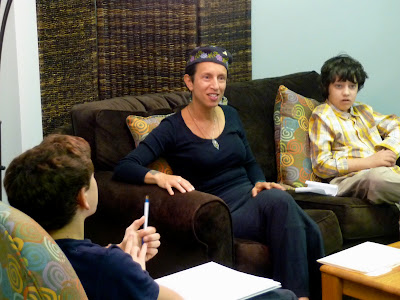
Maggid Galper started out by asking the students, What makes someone Jewish? They discussed various aspects--food, clothes, holidays, family heritage (especially through the mother)--but Maggid Galper said that in her mind (admittedly, she is of the Reform persuasion), people choose to be Jewish when they believe in and follow Jewish faith practices, regardless of family background or other factors.
Maggid Galper covered many of the great Jewish patriarch stories--Abraham, Isaac, Jacob and Esau, Joseph, Moses, Jonah, and David, among others. She raised the issue that some take these tales as literal truth, and others as teaching stories where events or people may be symbols for a larger truth. She explained that the name "Isreal" means "God Wrestler," and stated her belief that to be Jewish is to argue with or wrestle with "God" or spiritual truths or stories. "If you ask a Jew about a spiritual question," she claimed, "You'll get 10 different answers." But in Maggid Galper's mind, that is a good thing.
What was particularly great about listening to Maggid Galper, though, was that she also talked about the stories of women found in Jewish writing. So it was that we heard the version of the Abraham and Isaac story in which Abraham's wife, Sara, is the one to rescue Isaac, or the important role Mose's sister, Miriam, had in protecting Moses and making sure the flight from Egypt and search for the promised land was successful.
She talked about the Torah, made up of black writing, known as "black fire," and white space, known as "white fire." She related that to a story about Miriam, who received a gift of an empty box from the angels while Moses was receiving the Torah on Mt. Sinai. White fire, she said, was given to women to represent all the wonderful, valuable stories and wisdom that are NOT contained in the Torah. Finding and telling those stories, according to Maggid Galper, is the purview of women--a teaching that I just loved.

It was a great gift to have her, and both the students and I learned a lot to add to our understanding of the rich traditon of Judaism.
Saturday, October 16, 2010
Facebook Investor Establishes Grants for Entrepreneurs to Establish Businesses Instead of Going to College
(Preface: Wow! It is Facebook Again! My husband has been out of town all week, but now that he is back, I've DEFINITELY going to see "The Social Network.")
Last month, I wrote a post on "Is Going to College an Economic Mistake?" that discussed the rising costs of a college education and the diminishing returns of achieving an undergraduate degree, especially if one has to go into great debt to finish the program. In that post, at least one financial adviser said that children would be better served if parents gave them $10,000 to start a business instead of paying college tuition, which would give them much more practical knowledge and experience and would, if they went to college, make their time there much more focused and valuable. The number one question I got from friends who had read that post was, "Well, great, but where am I going to get $10,000?"
Here is one possibility.
Peter Thiel, who is currently a hedge fund manager and venture capitalist, but is most famous for being a co-founder of PayPal and an early investor in Facebook (he is portrayed in the movie "The Social Network" by CSI's Wallace Langham), has established a new grant program for entrepreneurs. Called the Thiel Fellowships, Thiel is offering up to $100,000 to 20 individuals or teams (up to four people) under 20 years of age who want to pursue their technology-based entrepreneurship dream rather than go to college.
Most of the opinion pieces I have read about this program excoriate this grant program for distracting young people from college and promoting Thiel's capitalistic vision. But to be fair, that might be due to my own biases in websites and reading materials, given that Mr. Thiel is an acknowledge ultra-libertarian and I am....not. And I have to say that I don't necessarily agree that this is a terrible program.
For one thing, the Thiel Fellowships are targeted towards only 20 projects, or a maximum (if every project has the maximum number of participants) of 80. Given that there were a record 2.6 million students in U.S. higher education in 2008, that is only a drop in a drop in a drop of the bucket of college students. I don't think the Thiel Fellowships are going to dissuade any significant number of students from attending college.
But I do think that the Thiel Fellowships is an acknowledgment of something that we as parents as well as citizens as well as policy makers don't like to admit--that college isn't for everyone. So do I want my son to go to college? DEFINITELY. But if we get there and that's just not the right path for where he is in his life journey, then I think I need to let go of that. Because in the end, it is his life, not mine. And if he happens to be one of those advanced thinkers who has an idea that could transform life as we know it---like Apple Computers did, or Microsoft did, or Dell Computers did, or Google did--then this program, with not only money available, but also access to mentors of the caliber or Thiel and his associates, might be exactly what is needed. To me it looks like kind of a MacArthur genius grant for young entrepreneurs.
I am particularly persuaded by what Thiels says is the motivation behind the grant. In the video in which he announces the program (around point 15:20 on the linked video), Thiels says he established the grants because he is afraid that the increased debt that college students are taking on in order to complete college are reducing their ability and/or willingness to take the kind of risk it takes to create break-through technology that is needed to solve societal problems like alternative energy or the next level of computer applications. Again, I think he is probably right in that assessment.
So I'm not concerned about 20-80 students a year receiving money to receive an education in hard knocks instead of in the Ivy Tower (as much as I loved that time myself). Actually, my real hesitation is that this may not not really a grant program at all, but a way for Thiel to cull the brightest thinkers and to get to invest in whatever is the NEXT Facebook or PayPal or whatever.
Of course, I'm not saying this is necessarily a program for middle schoolers. But if your child wins the programming contest I included in a previous post, Thiel (or someone like him) may be offering her/him an alternative path once she/he gets through high school.
Friday, October 15, 2010
Middle School Required Reading
I was browsing through a local bookstore this week, and realized that they had a table with the books that were required reading for nearby middle schools. So I examined the books to get some ideas about what fiction middle schools were studying these days and to see how my son's reading compared to that.
The table had the books required by six different middle schools, four of which were private and/or religious schools, and two of which were public schools. However, out of the 49 books on display, there were no overtly religious tracts. Looking over the selections, I had some surprises as well as some books that were expected.
What author would you think would be most represented among middle school reading lists? In this case, at least, it was Newbery Medal Winner Jerry Spinelli, who had three separate books on the table (a couple of which were in different piles, which I assumed meant that different schools had required the same book). Following Spinelli's record three novels, there were three authors that each had two books on the table--Newbery Winner Avi, Newbery Winner Lois Lowry, and ALA Best Books for Young Adults Winner Roland Smith. There were multiple other Newbery and ALA Best Book winners, and many of the titles were other books with good reviews that may not have quite made it up to the top competition level. But, after all, that is pretty much to be expected.
There was definitely an emphasis on multi-cultural literature. There were books about young people in Communist China, Nazi Germany, Africa, the Amazon, living with the Taliban, and trying to escape the war in Cambodia. There were a number of books on both Native Americans and on blacks living during the great Civil Rights tumult of the 1960's. I wasn't familiar with quite a few of those, and wrote down their titles as books to explore with my son.
On the other hand, there was few of the most popular contemporary literature. I didn't know ALL the books, but I saw very little science fiction or fantasy, and NO vampires. One school had City of Embers, and another had Hunger Games, but there was no Harry Potter, Percy Jackson, Kane Chronicles, or Ranger's Apprentice.
What I was really shocked by, however, was the complete dearth of older works that might be considered "the classics." Again, one or more less familiar books might have slipped by me, but the oldest book I saw was the 1944 Newbery Winner Johnny Tremaine. But there was no Jules Verne, no Mark Twain, no Mary Shelley, no Robert Lewis Stephenson, no Jack London, or any of the other 18th or 19th century writers I recall reading in middle school (although, admittedly, my memory could be confusing middle school books with high school). But surely there are SOME authors who wrote prior to the 20th century who belong on a middle school required reading list. There certainly will be some in our middle school literature classes.
Subscribe to:
Posts (Atom)