I wanted to share a website I discovered recently and now love. It is an art appreciation/art history website called Smarthistory.
The backbone of Smarthistory is (at this point) over 400 videos on different pieces of art, artists, or art period or concepts. The home page basically organized these by timeline, so they fit in well as an art history resource, or as a way to quickly add art content to a history lesson. However, inside the website you can search for videos not only by time, but by style, artist, or theme--which makes it a very flexible resources for incorporating art content in other kinds of lessons as well.
One way this website really stands out, however, is that there is an entire section on how users can make their own similar videos. It covers the technological tools to work with images and video, advice on approaching presenting art, tips on interviewing art experts, and even philosophical discussions on the difficulties of combining text and educational resources with the experience of appreciating a piece of art. This helps both students and teachers be not only a consumer of Smarthistory's videos, but a potential creator of their own reflections and mediations on art.
Smarthistory also has some suggested curricula: a 15 week Art History Survey (Western Culture) and a 15 week Art Appreciation Survey (again, Western Culture). These were developed for the college level, but I think they could be very helpful, perhaps not for middle schoolers, but definitely for high school, especially those preparing for AP exams in related history or art areas. For teachers, Smarthistory has been developed under a Creative Commons license, and they encourage teachers to embed their videos in their courses and online syllabi (with proper attribution, of course--but they give you the proper citation on their website.)
Smarthistory was developed by some experienced teachers of art history/art appreciation, and it shows. However, they have recently merged with Khan Academy, which I think is a win/win for both groups. Khan Academy gives Smarthistory more technological and institutional support, plus access to a much larger user base, while Smarthistory expands Khan's more math/science/technology focus into a strong curriculum in the humanities, and gives a softer, artistic edge to their rather geeky presence on the web.
All in all, I think it is a very well done project that adds a lot to our online resources on Western art.
Showing posts with label art. Show all posts
Showing posts with label art. Show all posts
Friday, April 27, 2012


Wednesday, April 25, 2012
Craft Coral Reef
I haven't been blogging as much recently because I've been so involved with the Healing Oceans Together (H2O) environmental education and awareness group that my son is helping to organize. (Regular readers of this blog may remember the Great Sea Slug Beauty Contest that H2O ran earlier this year.)
Now the group has moved on from raising awareness about sea slugs to encouraging people to help save the rapidly-disappearing coral reefs. The first step in the process is that H2O is creating a community-based Craft Coral Reef to exhibit at ChambersArts, an art gallery in downtown Cary. This artistic version of a coral reef, which will incorporate crochet and knitting, origami, beading, and other crafts, is supposed to remind people of the precious beauty of the coral reefs, educate them about the important role they play in our ocean ecology, and inspire them to take actions to help protect and preserve them.
We've been holding a series of FREE public workshops to get other people crocheting and crafting along with our group and contributing to the growing reef. So far we've held three public workshops, and the results have been great.
Before launching the project, H2O crocheted some sample creations to show people:


You can follow that blog if you are really interested. I'll also post some more photo updates to show you how our community Coral Reef grows.
Finally, next week we are launching another exciting initiative related to our "Save the Corals" campaign. So stay tuned for that announcement!
Now the group has moved on from raising awareness about sea slugs to encouraging people to help save the rapidly-disappearing coral reefs. The first step in the process is that H2O is creating a community-based Craft Coral Reef to exhibit at ChambersArts, an art gallery in downtown Cary. This artistic version of a coral reef, which will incorporate crochet and knitting, origami, beading, and other crafts, is supposed to remind people of the precious beauty of the coral reefs, educate them about the important role they play in our ocean ecology, and inspire them to take actions to help protect and preserve them.
We've been holding a series of FREE public workshops to get other people crocheting and crafting along with our group and contributing to the growing reef. So far we've held three public workshops, and the results have been great.
Before launching the project, H2O crocheted some sample creations to show people:

But a few weeks later, after the second public workshop, the Craft Coral Reef had grown to this:

Beautiful--and exciting to see the progress!
For more information on this project, including some photos from the workshops we've held, check out the complete write-up on the Healing Oceans Together blog.
You can follow that blog if you are really interested. I'll also post some more photo updates to show you how our community Coral Reef grows.
Finally, next week we are launching another exciting initiative related to our "Save the Corals" campaign. So stay tuned for that announcement!
Tuesday, April 17, 2012
Art Exhibit and Poetry Reading: ForWord
The art studio where my son takes art classes, Egg in Nest Studio, always celebrates National Poetry Month with an art exhibition and live poetry reading/performance event that celebrates the intersection between words and arts. The students write poems, create art pieces based on those poems, exhibit their art in the Halle Cultural Arts Center in downtown Apex, then read their poems to an audience, appearing onstage with professionals in various art forms who also discuss and display their talents. It is always a creative and inspiring event, and brings greater depth and understanding to the students' art studies.
This year, my son had two pieces in the show.

I really liked both of the them, especially because they were a departure from his typical techniques and demonstrated some of the ways that his wonderful teacher, Miss Jenny, is encouraging him to grow and stretch as an artist. On the other hand, they also contain elements of his inimitable style.
This was his first piece, which was based on the poem he wrote that was entitled, "The Saga of the Sproing-Boing," where he was experimenting with the sounds of invented vocabulary:

The second one had a two word poem written into the picture. The poem is "Extinction Distinction"... or maybe "Distinction Extinction"--he never would tell me.

Of course, my photos don't do the artwork justice. If you are in the vecinity of downtown Apex before the exhibit closes on May 5, go check them out in person at the Halle Cultural Arts Center (at the intersection of 10-10/Center Street and Salem Street).
Here is the artist showing the pictures to his father:

This past Sunday was the live event called ForWord. There, each participating got to read his or her poem with comments and encouragement from Miss Jenny:

But the student readings were interspersed with live performances and commentary on the connection between words and other art forms by a local music group, Jack the Radio:

a local grafitti artist, Blake Burnette:


poet and NC State writing professor, Chris Tonell:

and dancer Marie Garlock:

All in all, it's quite a big event, which Miss Jenny and her hard-working assistant, Miss Amanda, put on AT NO CHARGE for the benefit of the students--just one of the perks of taking class at Egg in Nest Studio:

Of course, the greatest perk of taking classes there is that each week the kids get to work with Miss Jenny, who is not only a wonderful and creative artist in her own right, but an intuitive and inspiring teacher who loves all her students--just like they love her (although some demonstrate it more than others):

What more could you want from the person teaching your children?
Tuesday, April 10, 2012
Lesson Plan: Pysanky-inspired Easter Eggs
Before we completely abandon the Easter theme--

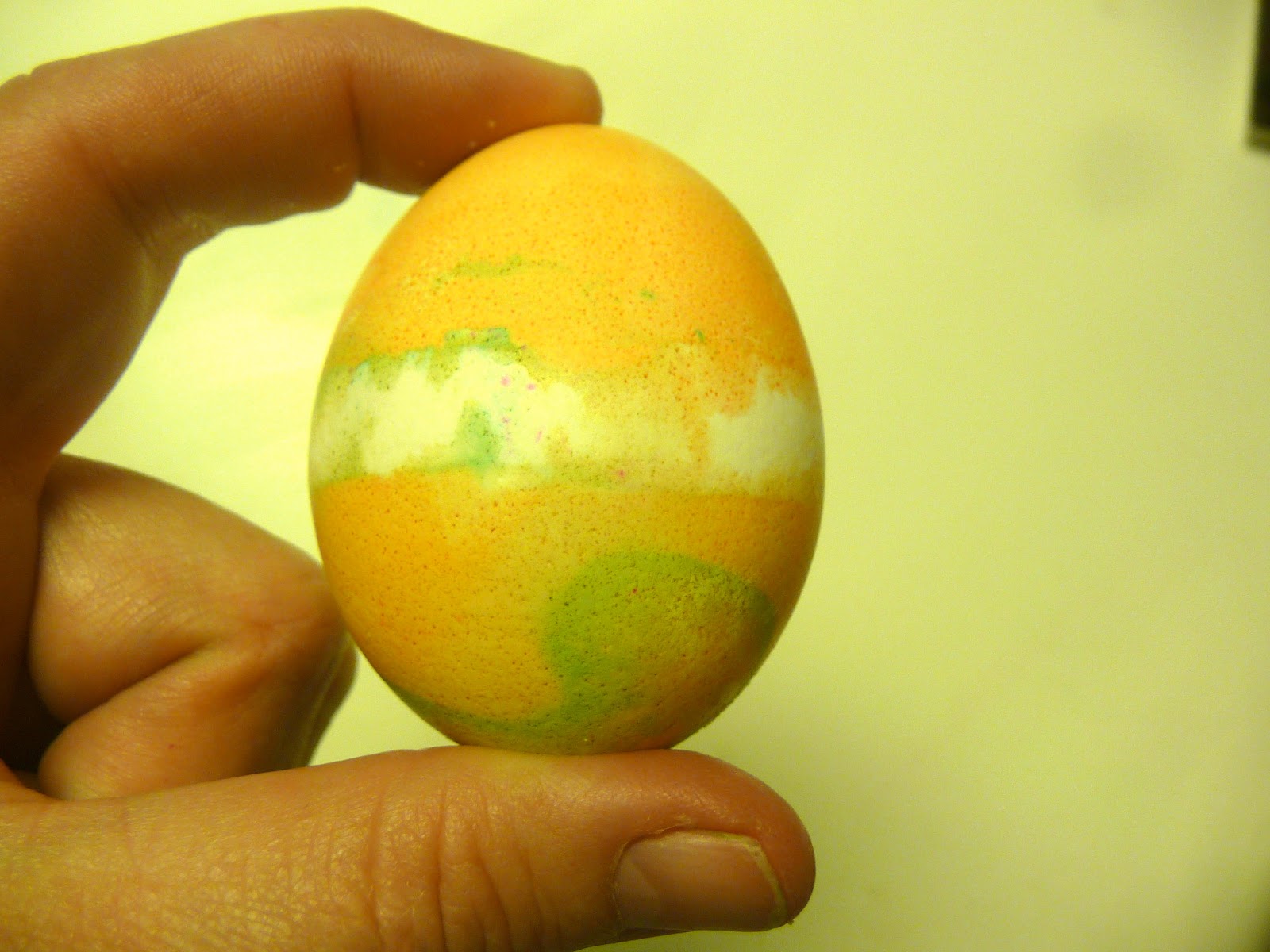
Last week in our World Religion class, we made eggs inspired by the Ukrainian technique of decorating eggs called Pysanky. The traditional art of Pysanky is kind of like batik on eggs; that is, the artists uses wax to over up the parts of the egg they want to keep the existing color, then dip the eggs into increasingly dark dyes. So, for example, they first cover up what they want to remain white, then dip the egg into yellow dye. Next they apply more wax to the areas they want to keep yellow (without removing the wax on the white areas), and then dip the egg in the next darkest color (usually orange or light pink). This continues until the eggs have been dyed their darkest colors, usually dark blue, purple, or black. After they have dried completely, the artist uses heat to remove the wax, revealing the multi-colored designs the wax have protected over multiple dying cycles. They can end up being really fabulous.
Obviously, this is a long and involved process that doesn't fit well into a limited class time. So we kind of faked our way through it by using masking tape instead of wax. We couldn't get the fine lines of true Pysanky, and with the number of people we had and our time constraints, the students couldn't dip them in too many colors. But it did give them the idea of how it worked so they could explore it more at home.
But more than simply a craft activity, we also discussed things related to Easter as we dyed our eggs. For example, I asked them what the life and/or death of Jesus had to do with eggs. They came up with lots of creative ideas, but then I let them know the answer--nothing, really. Dying Easter eggs, such as Pysanky, is a hold-over tradition from pagan times. In the case of the Ukranians, for example, eggs became sacred symbols and talismans because the ancient people worshiped birds because they could fly up to speak with the Sun God, which was their highest diety. So decorating eggs became part of their spring solstice celebration known in English as Ostara (which is where the word Easter came from). Because in these celebrations, the eggs were used as a symbol for spring and the rebirth of the Earth, when the Christians came along, they allowed the pagans to continue their old traditions, but just tried to convince them that the rebirth was not of the Earth, but of Jesus. It was techniques like these--assimilating pre-existing rituals rather than trying to eradicate them--that helped Christianity spread through so many different cultures to become the largest religion in the world today.
However, I also encouraged the student to think of the multiple dying cycles as representing the many different types of trials that Jesus went through during Holy Week, or the last week of his normal human life on Earth. That is, obviously the focus is on his physical death by crucifiction. But also during that week, he had to suffer doubts and abandonment (his friends fell asleep during his final hours of freedom), betrayal and denial by his disciples, false claims and judgements by both religious and political authorities, rejection by the masses who had acclaimed his entrance into Jeruselum only days before, physical torture, and attempts to mock and humiliate him. His ability to retain his faith and his dignity, and even to forgive those who participated in all these trials, are inspiring lessons in themselves, regardless of what religious beliefs you have about truth and/or meaning of the crucifixion and resurrection.
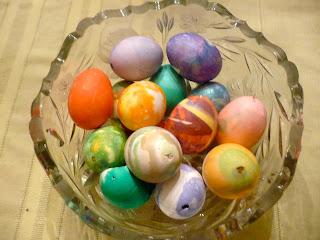
Anyway, we had a good discussion and created some pretty eggs, even in our rushed and limited situation. Here are some of the eggs we made:



Last week in our World Religion class, we made eggs inspired by the Ukrainian technique of decorating eggs called Pysanky. The traditional art of Pysanky is kind of like batik on eggs; that is, the artists uses wax to over up the parts of the egg they want to keep the existing color, then dip the eggs into increasingly dark dyes. So, for example, they first cover up what they want to remain white, then dip the egg into yellow dye. Next they apply more wax to the areas they want to keep yellow (without removing the wax on the white areas), and then dip the egg in the next darkest color (usually orange or light pink). This continues until the eggs have been dyed their darkest colors, usually dark blue, purple, or black. After they have dried completely, the artist uses heat to remove the wax, revealing the multi-colored designs the wax have protected over multiple dying cycles. They can end up being really fabulous.
Obviously, this is a long and involved process that doesn't fit well into a limited class time. So we kind of faked our way through it by using masking tape instead of wax. We couldn't get the fine lines of true Pysanky, and with the number of people we had and our time constraints, the students couldn't dip them in too many colors. But it did give them the idea of how it worked so they could explore it more at home.
But more than simply a craft activity, we also discussed things related to Easter as we dyed our eggs. For example, I asked them what the life and/or death of Jesus had to do with eggs. They came up with lots of creative ideas, but then I let them know the answer--nothing, really. Dying Easter eggs, such as Pysanky, is a hold-over tradition from pagan times. In the case of the Ukranians, for example, eggs became sacred symbols and talismans because the ancient people worshiped birds because they could fly up to speak with the Sun God, which was their highest diety. So decorating eggs became part of their spring solstice celebration known in English as Ostara (which is where the word Easter came from). Because in these celebrations, the eggs were used as a symbol for spring and the rebirth of the Earth, when the Christians came along, they allowed the pagans to continue their old traditions, but just tried to convince them that the rebirth was not of the Earth, but of Jesus. It was techniques like these--assimilating pre-existing rituals rather than trying to eradicate them--that helped Christianity spread through so many different cultures to become the largest religion in the world today.
However, I also encouraged the student to think of the multiple dying cycles as representing the many different types of trials that Jesus went through during Holy Week, or the last week of his normal human life on Earth. That is, obviously the focus is on his physical death by crucifiction. But also during that week, he had to suffer doubts and abandonment (his friends fell asleep during his final hours of freedom), betrayal and denial by his disciples, false claims and judgements by both religious and political authorities, rejection by the masses who had acclaimed his entrance into Jeruselum only days before, physical torture, and attempts to mock and humiliate him. His ability to retain his faith and his dignity, and even to forgive those who participated in all these trials, are inspiring lessons in themselves, regardless of what religious beliefs you have about truth and/or meaning of the crucifixion and resurrection.
Anyway, we had a good discussion and created some pretty eggs, even in our rushed and limited situation. Here are some of the eggs we made:




Thursday, March 15, 2012
Lesson Plan: Buddhist Prayer Flags
Of course, we couldn't complete our World Religion unit on Buddhism without doing Buddhist Prayer Flags! This class was run by artist and teacher extraordinaire, the Reverend Donna Belt! She explained the tradition of prayer flags, and the fact that they are hung in a set order by color, which symbolize different elements. So the traditional order is:
Blue--representing sky
White--representing air or wind
Red--representing fire
Green--representing water
Yellow--representing earth
She discussed the fact that the flags are called "Wind Horses," and that the belief is that every time the wind moves the flag, it send the energy and prayers contained in the flag, not to a divine being, but through the space, blessing everyone. So it is a belief practice much in line with the Buddhist tradition of universal connection and compassion.

Reverend Belt helped the students create universal healing prayers involving all of the different elements. They they wrote those prayers on their flags, sometimes also decorating them with a horse image or other decorative elements.

Once they were completed, the teachers demonstrated the traditional way to hang a set of prayer flags...
First one

Then another


Then many

It can be a very powerful--and beautiful--way to talk about Buddhist beliefs.
Blue--representing sky
White--representing air or wind
Red--representing fire
Green--representing water
Yellow--representing earth
She discussed the fact that the flags are called "Wind Horses," and that the belief is that every time the wind moves the flag, it send the energy and prayers contained in the flag, not to a divine being, but through the space, blessing everyone. So it is a belief practice much in line with the Buddhist tradition of universal connection and compassion.

Reverend Belt helped the students create universal healing prayers involving all of the different elements. They they wrote those prayers on their flags, sometimes also decorating them with a horse image or other decorative elements.

Once they were completed, the teachers demonstrated the traditional way to hang a set of prayer flags...
First one

Then another


It can be a very powerful--and beautiful--way to talk about Buddhist beliefs.
Saturday, March 10, 2012
Lesson Plan: Zentangles
We did such a wonderful activity as part of our Buddhism unit in World Religions. One week we focused on Zen Buddhism, which has a great focus on being in the moment. I wanted the students to have a Zen experience, so we did three activities in a row in complete silence (a total of 30 minutes, which is a LONG time not to talk when you are 12-14).
First, we did a silent Zen meditation that focused completely on the breathing. That lasted for 10 minutes (and felt like a LONG 10 minutes for some of them, although others found it relaxing). We ended up with a 5 minute silent journaling activity, in which they wrote down their experience of the three events.
In between those, however, we did 15 minutes of this wonderful thing called Zentangle ®.
We used Zentangle as a drawing meditation. It is a deceptively-simple art form created by Maria Thomas and Rick Roberts that is supposed to improve the artist's focus, awareness, feelings of freedom and relaxation, and artistry by creating repetitive patterns on a small (3.5 inches) square of paper. The square is first divided into sections by a few lines, and then each portion of the square is filled with a different pattern. In its purest state, it is supposed to be only black and white, but some add colors as well.
The students and I all LOVED doing this. Compared to the breathing meditation, the students felt that the time seemed to fly by and that it was easy to maintain the silence. Making a Zentangle is very liberating, because even those who claimed "I can't draw" felt like they could draw lines and "doodle." It does capture your focus and your attention in a very relaxing way, and is mostly spontaneous, and yet repetitive. And it does draw you into kind of a Zen experience. Apparently, people are using it all sorts of way, including doing it before tests to get students into a relaxed and focused way, or as part of the process of addiction recovery and other related theraputic uses.
It's the sort of thing that is hard to explain. But I highly recommend you visit the Zentangle website, or other online resources about this new art form (one of my favorites is Zentangle Patterns), get the basic instructions, and try it yourself!
Below we have the beautiful tiles (as they are called by their creators, Maria and Rick) created by our class. As always, even though everyone was given the same materials and directions, the results turned out to be very different and reflective of the varied personalities in the group.


Saturday, February 11, 2012
This Weekend Is the Last Chance to Join in the Sea Slug Lovefest!
As I mentioned in an earlier post, my son's middle school environmental group, Healing Oceans Together, is running a FREE online contest entitled The Great Sea Slug Beauty Contest. They are asking people to vote for which of eight finalists is the most beautiful sea slug--judging not only on its appearance, but also its cool features. Click here to participate--it is anonymous and only takes a few minutes....ESPECIALLY if you are from one of these states:


- Idaho
- Kansas
- North Dakota
- Oklahoma
- South Dakota
- West Virginia
- Wyoming
Those are the only states that they haven't received any visits from, and they are really trying to get at least one vote from all 50 states (and we've got the District of Columbia, since that is where my father lives). So if you can, please vote so they can get the most participation possible. But the deadline is tomorrow, Sunday, February 12, so please act soon.
H2O also just put on two free educational workshops for the community about sea slugs. About 68 people participated in the workshops, held at the libraries in Raleigh and Apex, NC. In addition to scientific information about sea slugs and how people can help heal the oceans, the workshops featured making your own sea slug out of polymer clay or playdough (for the littler students), making sea slug valentines, playing games, and listening to sea slug stories. It drew a diverse crowd, and it was great to see the teens working with the toddlers!


Subscribe to:
Posts (Atom)