Before we completely abandon the Easter theme--
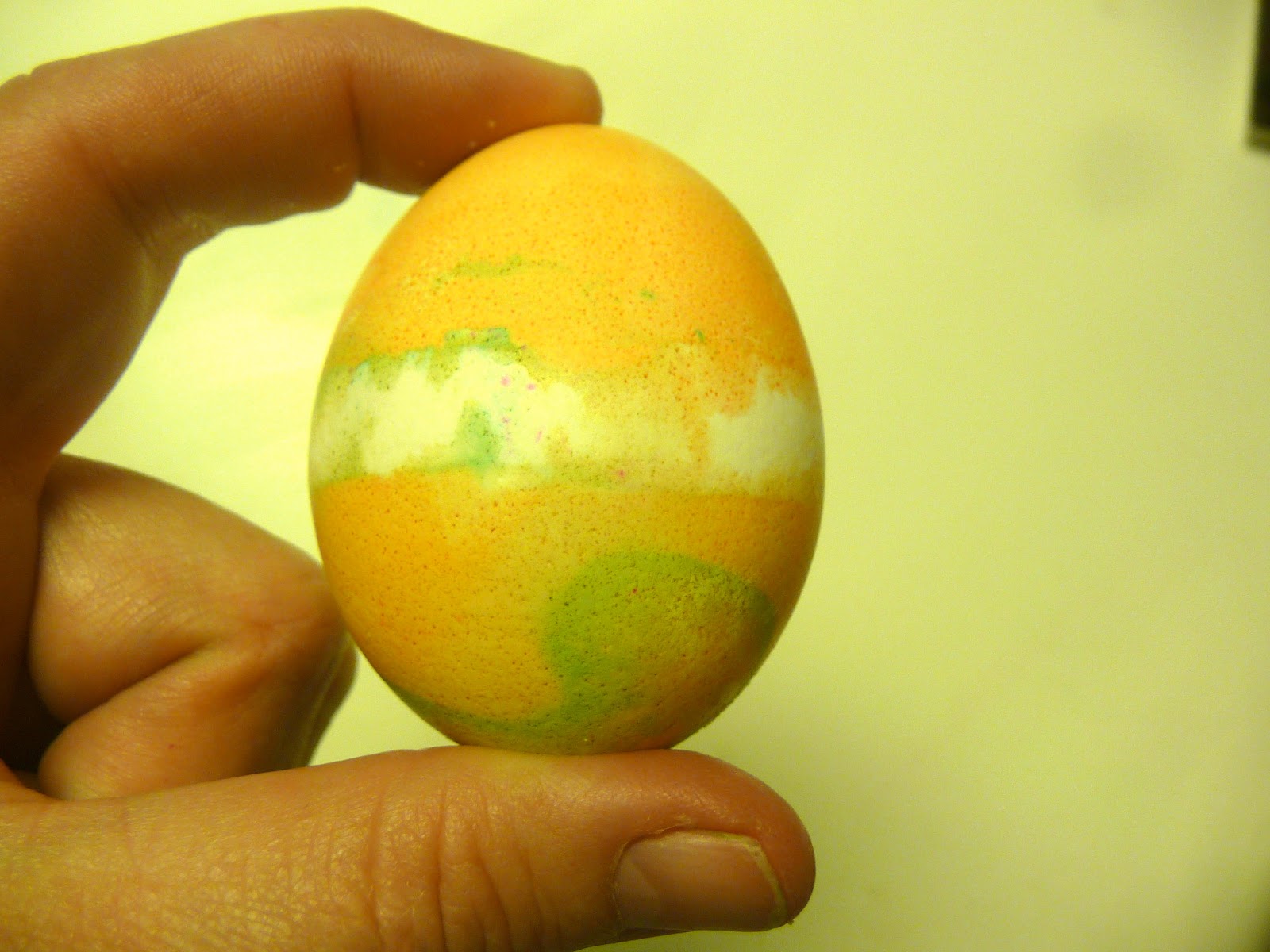
Last week in our World Religion class, we made eggs inspired by the Ukrainian technique of decorating eggs called Pysanky. The traditional art of Pysanky is kind of like batik on eggs; that is, the artists uses wax to over up the parts of the egg they want to keep the existing color, then dip the eggs into increasingly dark dyes. So, for example, they first cover up what they want to remain white, then dip the egg into yellow dye. Next they apply more wax to the areas they want to keep yellow (without removing the wax on the white areas), and then dip the egg in the next darkest color (usually orange or light pink). This continues until the eggs have been dyed their darkest colors, usually dark blue, purple, or black. After they have dried completely, the artist uses heat to remove the wax, revealing the multi-colored designs the wax have protected over multiple dying cycles. They can end up being really fabulous.
Obviously, this is a long and involved process that doesn't fit well into a limited class time. So we kind of faked our way through it by using masking tape instead of wax. We couldn't get the fine lines of true Pysanky, and with the number of people we had and our time constraints, the students couldn't dip them in too many colors. But it did give them the idea of how it worked so they could explore it more at home.
But more than simply a craft activity, we also discussed things related to Easter as we dyed our eggs. For example, I asked them what the life and/or death of Jesus had to do with eggs. They came up with lots of creative ideas, but then I let them know the answer--nothing, really. Dying Easter eggs, such as Pysanky, is a hold-over tradition from pagan times. In the case of the Ukranians, for example, eggs became sacred symbols and talismans because the ancient people worshiped birds because they could fly up to speak with the Sun God, which was their highest diety. So decorating eggs became part of their spring solstice celebration known in English as Ostara (which is where the word Easter came from). Because in these celebrations, the eggs were used as a symbol for spring and the rebirth of the Earth, when the Christians came along, they allowed the pagans to continue their old traditions, but just tried to convince them that the rebirth was not of the Earth, but of Jesus. It was techniques like these--assimilating pre-existing rituals rather than trying to eradicate them--that helped Christianity spread through so many different cultures to become the largest religion in the world today.
However, I also encouraged the student to think of the multiple dying cycles as representing the many different types of trials that Jesus went through during Holy Week, or the last week of his normal human life on Earth. That is, obviously the focus is on his physical death by crucifiction. But also during that week, he had to suffer doubts and abandonment (his friends fell asleep during his final hours of freedom), betrayal and denial by his disciples, false claims and judgements by both religious and political authorities, rejection by the masses who had acclaimed his entrance into Jeruselum only days before, physical torture, and attempts to mock and humiliate him. His ability to retain his faith and his dignity, and even to forgive those who participated in all these trials, are inspiring lessons in themselves, regardless of what religious beliefs you have about truth and/or meaning of the crucifixion and resurrection.
Anyway, we had a good discussion and created some pretty eggs, even in our rushed and limited situation. Here are some of the eggs we made:
Showing posts with label Pagan. Show all posts
Tuesday, April 10, 2012
Sunday, April 8, 2012
Spring and Gratitude
Today is Easter in North Carolina, so Happy Easter for those who celebrate this day! Of course, the Jewish holiday of Passover has just occurred, so a belated Happy Passover to those readers. And it wasn't too long ago that the Pagan holiday of Ostara took place, so good thoughts towards any of you who might be Wiccan or other variations of Paganism. And there are probably some Spring celebrations in Islam, Hinduism, and Buddhism that I just don't know about; if so, happy thoughts in your direction as well.
I'm sure that it is no coincidence that so many of these religious celebrations take place in Spring. You don't have to follow any religious practice at all to be uplifted and inspired by the rebirth that takes place in Nature at this time of the year. I'm noting that even though our past winter was so mild that it seems like turning into Spring wouldn't be that big of a deal, but the flowers and such seem even more intense this year, as if knowing they had to put on an extra special show in order to show off the contrast between the seasons in a year of temperate temperatures.
There are two non-religious Spring-related occasions that we particularly celebrate in our household, or at least we have for the past few years. One is the opening of our local Farmers' Market in Cary. While we do have access to fresh vegetables all year round at other Farmers' Markets in the area, the Cary market is shut down from December through March. So by the time the first Saturday in April rolls around, I can't wait to see all my farmer friends and start buying fresh, local produce again directly from the producers. And this year was extra special because, after a hiatus of a couple of years, the Cary Farmers' Market has once again move to downtown Cary, and is in even closer walking distance from my house than it was previously! That means a lot to me in my ongoing efforts to reduce our family's carbon footprint.
Another event of great note in our home is the first fresh local strawberries of the year. Every since reading Michael Pollan's The Omnivore's Dilemma (yes, that book AGAIN, for my regular readers....what can I say, it changed my life), I no longer buy fresh strawberries except locally during our relatively short growing season in North Carolina (read the book to find out why). But I seriously love strawberries, so it is a big deal when they return to our diet, albiet for only a few, short, precious weeks. So only buying local strawberries in season has really raised my appreciation for this wonderful fruit that is gone all too soon.
But this year, for the first time since I've been shopping at the Farmers' Market, Market Opening Day and First Strawberry Day coincided! Apparently the mild winter has coaxed the local strawberries into blooming early. So, joy of joy, I bought a mess of them, and they will be part of our Easter celebration at our spiritual center (we are having an egg hunt for the children, but the eggs will contain fruit instead of candy) and our Easter dinner table. But I have already welcomed the strawberries by opening a bottle of champagne with a friend and drinking the sparkling wine with our first strawberries in the glass as well.
So pick what inspires you--your religious or spiritual tradition, Nature's beauty, the longer days, the warmer weather, or the return of the seasonal crops. Spring is great time to be thankful for all the wonderful things that this planet continues to provide us, despite our often not-too-great stewardship of its resources.
I'll end with a lovely video on Nature and gratitude that my friend Lorna shared with me. I hope you find it as inspiring as I did.
Enjoy!
Labels:
celebration,
Christianity,
farmers market,
food,
gratitude,
holidays,
Judaism,
Michael Pollan,
nature,
Pagan,
science,
spring,
TED,
The Omnivore's Dilemma,
video
Thursday, December 22, 2011
Winter Solstice 2011 at the Zoo
Happy Solstice! It seems appropriate that we celebrated the shortest day in the year by going to an exhibition of lights (articifical) at the National Zoo, an annual holiday event called ZooLights.
You enter under an arch of lights....
and follow the pathways, which are decorated on both sides with lights strung all over the trees:
Sometimes there are lit patterns along the path itself:
Since it is the zoo, there are also many light exhibits featuring animals, some of which are animated:
My son likes the marine animals display:
especially the cephalopods:
A number of the enclosed display areas--the reptile house, the small mammals house, the great apes, etc.--are also open, so you can see some actual animals as well as the ones in lights.
There are even a few places where the lights on the tree change in time with the lively holiday music that is playing:
It was a beautiful mild night, and a great place to be to celebrate the Solstice in the nation's capitol.
Wishing you the best on this special evening as well.
| Sign on Connecticut Avenue Inviting Visitors |
You enter under an arch of lights....
and follow the pathways, which are decorated on both sides with lights strung all over the trees:
Sometimes there are lit patterns along the path itself:
Since it is the zoo, there are also many light exhibits featuring animals, some of which are animated:
My son likes the marine animals display:
especially the cephalopods:
A number of the enclosed display areas--the reptile house, the small mammals house, the great apes, etc.--are also open, so you can see some actual animals as well as the ones in lights.
There are even a few places where the lights on the tree change in time with the lively holiday music that is playing:
It was a beautiful mild night, and a great place to be to celebrate the Solstice in the nation's capitol.
Wishing you the best on this special evening as well.
Subscribe to:
Posts (Atom)