I've said before that Jay Mathews of the Washington Post is one of my favorite education journalists. He has been their education reporter for decades, so he has a deep background in personalities, policies, programs, and research in the field.
This week he wrote an article right up our alley that was called "8 Subtle Ways to Prepare Middle Schoolers for College." He has long been an advocate that their are great educations to be had at all sorts of different colleges, and generally works to relieve the pressure students and parents put on themselves in terms of having to get into ONE particular college. So his is not going to be a "Tiger Mom" type of list of intense academic achievements. In fact, much of his list, which he compiled from talking to college admissions experts, he says is really more geared to making middle schoolers into better people, which will help them in college along with the rest of their life.
The Mathews/Educational Experts list is:
1. Notice what they enjoy, and help them do more of it.
(Colleges like students with depth, and students should spend time doing what is important to them, not racking up achievements to look good.)
2. Make sure your child knows that B's are fine in middle school and that fun is important.
(Don't start the pressure too soon, especially for overachievers.)
3. Enroll them in Algebra 1 in eighth grade.
(This prepares them for high school level work.)
4. Insist they develop some practical housework skills.
(They are going to have to balance taking care of themselves with their college workload.)
5. Flavor family trips with a bit of college atmosphere.
(My husband makes fun of me about this, but my family's vacations always included stopping by a local campus or two.)
6. Encourage children who are curious about the world to take a foreign language.
(My son and I just participated in an online class this afternoon with students from three different continents. It truly is a global world.)
7. Character counts. Encourage its development.
(Mathews admits this can be hard with emotional early adolescents, but suggests we start by being good role models ourselves.)
8. Do everything you can to encourage reading.
(One of his experts says the highest correlation among the very best test-takers is a strong background in reading.)
That's a pretty good list, I think. But some of his readers added a few others:
--More sleep for teens/preteens
--Teach listening skills
--Raise career awareness and preparation requirements(in both college-required and non-college fields)
--Have them write
--Make sure they spend time outdoors in nature
Any other suggestions you have for low-key ways to help prepare 10-14 year olds for their college experience (if they choose to have one)?
Friday, February 4, 2011


Thursday, February 3, 2011
Walking Backwards
At our Teaching Your Middle Schooler conference last summer, the keynote speaker said that one reason that middle schoolers have gotten such a bad rep is that, since they are figuring themselves out and their bodies are going through so many changes during that period, that they can change so much from day to day, and that is difficult for those of us with our plans about how to educate them and parent them and coach them, etc., to deal with. And I see how that can be frustrating.
But at our spiritual center, we study the writings of a woman named Byron Katie, whose most famous book is called Loving What Is. Katie argues that the suffering in our life comes from us resisting the things that show up in our lives, or fighting against "what is." That is to say, there are things in our lives that we might not like and want to work to change, and that is fine. But we spend so much time fussing about the fact that they are in our lives, and they SHOULDN'T be in our lives, and we DON'T WANT THEM in our lives, and so on, that we have no energy left to deal with them.
And I think that is a great insight to bring to dealing with our middle schoolers. Of course, when we've set up our schedules to get them to the classes or activities that they LOVE, except that now they can't stand them, or (this happens in my house all the time) have bought a huge bunch of bananas because for three weeks we've run out of bananas about every second or third day and I get complaints about not having any, except this week no one will touch bananas with a ten foot pole and they rot...well, yes, that can be annoying and waste money and all that. But it makes it easier if we understand that this sort of thing is what children are SUPPOSED to be doing, according to developmental theory.
So what if we took the position that the conflicts that arise in these situations are not the children's fault, but our fault for resisting what is our current reality. Or how about if we not only stopped resisting these changes, but embraced them.
This just came up today because we went for a hike at our local nature center, Hemlock Bluffs. My son and I go hiking there A LOT, and have for his whole lifetime; I was figuring out today that we must have hiked the looped trails at Hemlock Bluffs EASILY over 250 times in his life. The trails have numbered stations with educational materials, but we have done them so often that we no longer stop and read the information. But they are trails that we've done over and over in all seasons and all sorts of weather, sometimes in the format of formal classes offered at the center, and sometimes with friends, but usually just on our own.
Anyway, we went on the trail today, and we were the ONLY PEOPLE there besides the staff. It was funny, because it seemed cold because yesterday the temperature was nearly 70, but today the temperature dropped 25 degrees to the mid-40's. So it seemed cold, but it was actually slightly warmer than the average temperature for Cary in February. Another great illustration about how much and how quickly our physical environment can change, and how our perception is based on comparison to what we experienced the day before, not the reality of what we should expect for this time of year.
So we were going on our hike, and my son said, "Let's walk the trail backwards.'' So he headed off in the direction from the bigger numbers of the educational stations to the smaller ones. I, having been raised to "do things the right way," had a slight pang of guilt, but followed his lead. And we had a lovely walk, pretty much in silence since we weren't talking (he tends to run ahead, so we can't really talk when he is 50 yards in front of me) and we didn't pass anyone else to exchange pleasantries.
But I realized that by walking backwards, I noticed all these things about this familiar route that I don't usually notice. I was seeing the opposite side of the trees and the bridge and the steps and all the sites I know so well, and it all looked so different. It was amazing--and quite inspiring. It reminds me of how much of my life I walk through without really noticing or experiencing, because I am expecting today to be pretty much like it was yesterday.
So I'm thinking now that maybe that is something we all need to do more of in our life--walk through it backwards. Take a different route, re-order our routine, see things from a different angle. Just wake up to our own lives and to experiencing all the little things that make up its magnificence. And if that is your goal, then our wonderful middle schoolers with their ever-changing opinions and desires and demands are a gift, not a problem. Because whatever you want to say about early adolescents, they aren't the ones who are stuck in a rut.
So let's take an opportunity to thank our middle schoolers for the blessing they bring to our lives by shaking them up. All too soon, their lives may be as settled and uni-directional as ours are. Let's all rejoice in the times we can share in walking backwards in our lives.
Curriculum Resource: Fling the Teacher
One of the fun free educational software programs that you can use to check your students' knowledge on a subject is "Fling the Teacher." In this software, students get to change the look of the "teacher"--hair and skin color, hair style, mouth/teeth, accessories (glasses and earrings), etc.--stick him in a barrel, and fling him through the air using a trebuchet they construct by answering 15 questions correctly. It is pretty much just a fact recall quiz, but it is kind of cute and the students enjoy building up their equipment until it is ready to toss the digital professor into the air.
We used this software this week in our 19th Century History Coop to review some of the facts about the Westward Expansion and Industrial Revolution in the US. The link for this game is: http://www.solpass.org/7ss/Games/WestwardExpansion.html
There is another quiz about this time period as well, which you can see at: http://www.lisd.net/schools/briar/fling/Westward%20Expansion.html
What is nice about these games is that they are quick, so you can complete them in a short enough period of time that the students don't lose interest. You can do them several times in a role to get enough right answers to complete your trebuchet and fling the teacher; the software scrambles the answers (and sometimes the questions), so the students really learn the questions they answered incorrectly at first on subsequent tries of the problem. Best of all, the software is open to everyone to create your own quiz using your own questions for whatever subject you are studying.
Here is a website with a list of Fling the Teacher quizzes from American History.
Here is one with questions about World, but mostly European History.
Here is one with other subjects.
And if you want to make your own, here is where you download the software.
Or, even better, get your students to create one to demonstrate how much they have learned!
Tuesday, February 1, 2011
February Giveaway: The Strange Case of Origami Yoda
I had so much fun with the HOAC giveaway we had at the end of the year, I've decided I would just do some giveaways on my own. I thought that the best way I could show my support for some of the books that my son and I just love and think should be better recognized is to buy another copy and give it away to one of the readers of my blog. I hope it will send a little income towards some wonderful writers and raise some awareness of their books.
So in honor of Valentine's Day, my February giveaway will be the humorous, yet thoughtful, book by Tom Angleberger, The Strange Case of Origami Yoda. I've written about this book before, and included it in my Newbery 2011 Top 5 List. But here is my Valentine's Day description of the book:
Because my goal is to get more people to hear of these lovely books that I think are under-acknowledged, I would also love for you to send out this information through your networks. So anyone who announces this giveaway through their blog, Facebook page, Twitter feed, email loop, or other social network will get an additional five (5) entries under their name. You can just email me at ccross@mindspring.com to let me know that you are helping to spread the work, and I will give your name five more chances (but you need to sign up through the comments as well).
The winning entry will be selected by the random number generator at Random.com on--when else?--Monday, February 14. Be sure to check back then to find out if you won!
But even if you don't win--look for this book at your local library, or go buy your own copy. It's a fun, uplifting book for this age group.
So in honor of Valentine's Day, my February giveaway will be the humorous, yet thoughtful, book by Tom Angleberger, The Strange Case of Origami Yoda. I've written about this book before, and included it in my Newbery 2011 Top 5 List. But here is my Valentine's Day description of the book:
If you are in 6th grade, and just starting to tip your toes in the murky waters of relationships with the opposite sex, would you take dating advice from....Yoda? And not real Yoda, but a Yoda finger puppet made out of paper through origami? A finger puppet that sits on the finger of Dwight, the weirdest kid in school?
But as more and more of Origami Yoda's predictions come true, Dwight's classmates start to wonder what the deal is. They work together, writing down their separate experiences in a shared notebook, trying to figure out what is going on. Could Origami Yoda possible be the real deal? Is the Force actually with him? Or could they, maybe, have underestimated the unusual students who voices Yoda's predictions?
This book is a funny and easy read, and it is easy for students who are around the middle school age range to relate to the characters. It's a great book for boys--who love solving mysteries and Star Wars--as well as for girls--since it deals with relationships and even--GASP--emotions. It has a satisfying ending, a great message, AND--instructions for making your own Origami Yoda. What 10-14 year old can't find something in that combination to love?So, for a chance to win this FABULOUS book, you just have to enter your name in the comments section below. If you can, I would love it if you would also recommend a book relating to love (for Valentine's Day) that is appropriate for this age group. It doesn't have to be romantic love (or really, like--mostly, people aren't truly falling in love until the YA novels, but tend to have crushes and such in the early adolescent books)...it can be familial love, platonic love of a friend, love of a pet or animal, whatever. But only your name is required.
Because my goal is to get more people to hear of these lovely books that I think are under-acknowledged, I would also love for you to send out this information through your networks. So anyone who announces this giveaway through their blog, Facebook page, Twitter feed, email loop, or other social network will get an additional five (5) entries under their name. You can just email me at ccross@mindspring.com to let me know that you are helping to spread the work, and I will give your name five more chances (but you need to sign up through the comments as well).
The winning entry will be selected by the random number generator at Random.com on--when else?--Monday, February 14. Be sure to check back then to find out if you won!
But even if you don't win--look for this book at your local library, or go buy your own copy. It's a fun, uplifting book for this age group.
Monday, January 31, 2011
Why Don't Women Contribute to Wikipedia?
I've had a terrible muscle cramp or something in my right shoulder blade today, so I'm not really up to much blogging tonight. So I thought I would just post an article that I found intriguing, even though it doesn't really deal directly with middle schoolers, although it does have some impact at all ages....
The Wikimedia Foundation, the organization that is responsible for Wikipedia, did a study that showed that only 13% of people who write Wikipedia entries are women. The question, of course, is why such a collaborative, community-driven, and open-access project as Wikipedia is so male dominated. There have been a rash of articles written investigating this subject, but my favorite is this one by the New York Times.
Does it matter? Well, I think it probably does (which is how I connect it to middle schoolers). Wikipedia is just such an important resource in our digital age. A recent Pew survey reported that over half of the adults who regularly use the Internet rely on Wikipedia for information (with usage skewed towards the younger adult population). I use it with my middle schooler at least several times a week. It is one of the resources that I've taught him is relatively reliable as an information source. But while I trusted the community vetting of information, I had never imagined that there would be such a gender difference among the writers.
With such an overwhelming percentage of male contributors, however, I now have to assume an underlying male bias. The New York Times article reports several instances of topics of interest to women that contain only a few paragraphs, whereas topics of interest of men have much more extensive entries.
Is this really a problem? I'm not sure, but intuitively, I don't like it. What should we do about it? I don't know. But I'm just glad to be aware of the issue, and to perhaps be a bit more careful about recommending it to my middle schooler as an exclusive or definitive information source.
Sunday, January 30, 2011
Lesson Plan: Arts of the Regency Period
In our history coop, we do an art for each area and period we study. We've been studying Regency England, and it was my turn to do the art. So the art that I selected--one that is mentioned in books by Jane Austen and other writing during that time--was quilling (also known as paper filigree).
Quilling is a design out of rolls of paper, created by rolling thin strips of paper around a feather quill. It was used to decorate cards, scrapbook pages, or picture frames. It was traditional made up of either simply decorative scrolls, or to depicts items from nature, such as flowers or animals or insects.
I created the following picture as a quasi-traditional picture of Regency quilling:

But the students took it in new and creative directions. We had two abstracts/ornamentals:


(This looks rather Fibonacci-like to me, which reminds me of my beloved book, Blockhead)
One flora:


And then, one squid:

It is a fun, pretty easy, and less familiar craft, and I think it is a great addition to a unit on Regency England.
Quilling is a design out of rolls of paper, created by rolling thin strips of paper around a feather quill. It was used to decorate cards, scrapbook pages, or picture frames. It was traditional made up of either simply decorative scrolls, or to depicts items from nature, such as flowers or animals or insects.
I created the following picture as a quasi-traditional picture of Regency quilling:

But the students took it in new and creative directions. We had two abstracts/ornamentals:


(This looks rather Fibonacci-like to me, which reminds me of my beloved book, Blockhead)
One flora:

Several birds, each beautiful and unique:
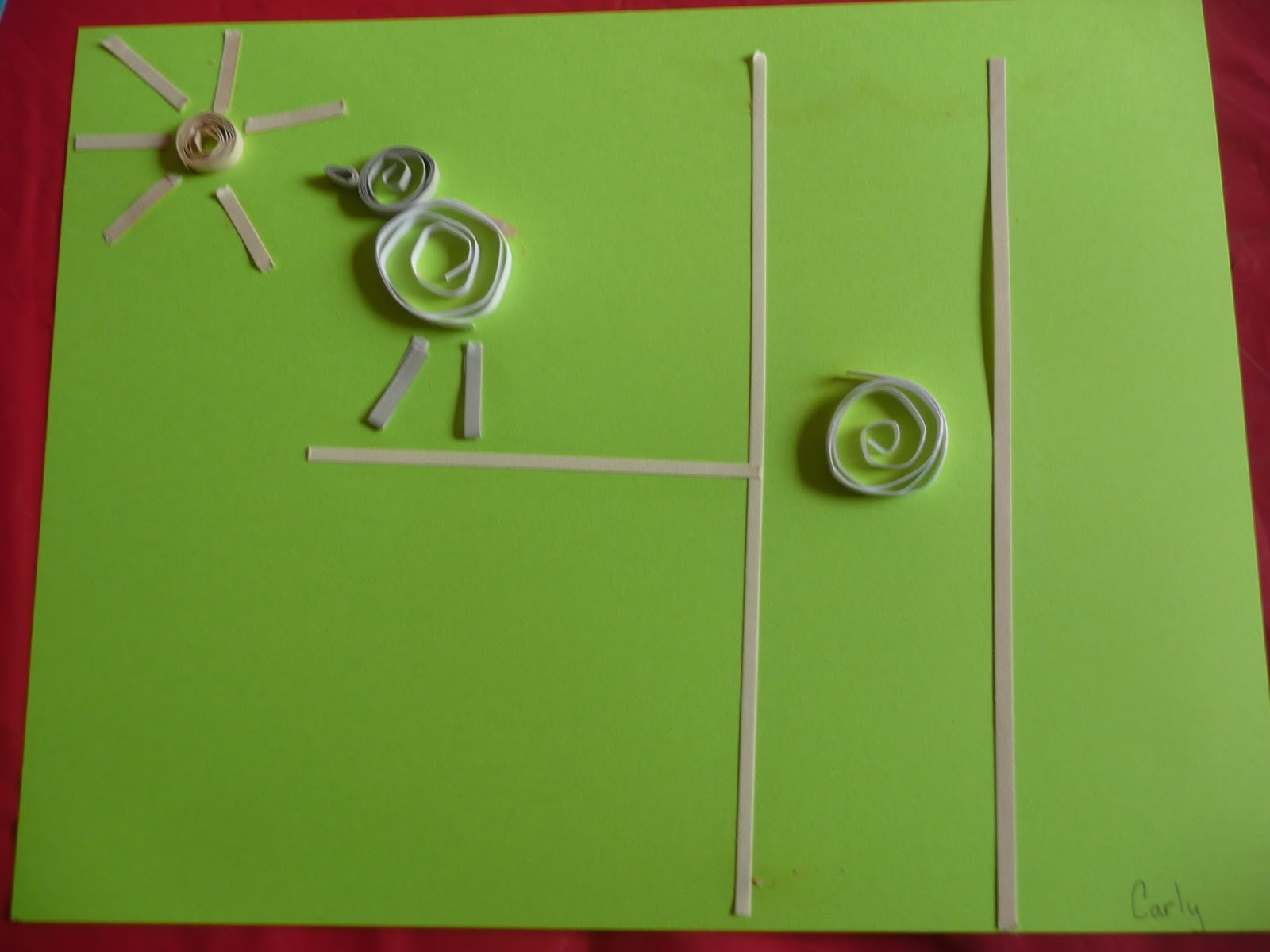


It is a fun, pretty easy, and less familiar craft, and I think it is a great addition to a unit on Regency England.
Saturday, January 29, 2011
Picture Books for Middle Schoolers
As long as I am on my "don't abandon all youthful tools" kick...
Pragmatic Mom had a thought-provoking blog post where she asked people to help compile a Top 10 list of Caldecott Medal and Honor Books. It was tough, but I finally came up with this list based on my self-imposed rules:
--No more than one book from any one author
--Selection was more than just that one book, but also considered body of work by that author
Going in order from oldest to newest, my top 10 choices were:
Bartholomew and the Oobleck by Dr. Seuss, pseud. [Theodor Seuss Geisel]
The Snowy Day by Ezra Jack Keats
Where the Wild Things Are by Maurice Sendak
Anansi the Spider: A Tale from the Ashanti , adapted and illustrated by Gerald McDermott
The Polar Express by Chris Van Allsburg
Tuesday by David Wiesner
Seven Blind Mice by Ed Young
In the Small, Small Pond by Denise Fleming
What Do You Do with a Tail Like This? illustrated and written by Steve Jenkins and Robin Page
Zen Shorts illustrated and written by Jon J. Muth
And while some might think that Caldecott winners were too young for middle schoolers, I would disagree. For example, we still create Oobleck, sometime for science, sometimes just for the fun of it. I used Tuesday in a writing class (for a lesson of "show, not tell" in writing) and Seven Blind Mice in a religion class (as a metaphor for trying to explain the divine). I anticipate using Anansi the Spider when we get into Jung, and Zen Shorts when we get to Buddhism. And, of course, we once again celebrated the Christmas season with our annual reading of The Polar Express.
But it got me to thinking that maybe I would create my own Top 10 list of Non-Fiction Picture Books for Middle Schoolers, based on the resources I have been using in my classes for this academic year. So here are the Picture Books that have figured most prominently in our 6th Grade lessons so far:
Math (but really, so much more)
Blockhead: The Life of Fibonacci by Joseph D'Agnese I wrote an entire post about this book, which we love, love, LOVE. We used it not only for math, but for history, art, and even literature, since it has inspired us writing some short poems known as Fibs.
History (we are studying 19th Century World and American history)
Charles Dickens: The Man Who Had Great Expectations by Diane Stanley
The Extraordinary Mark Twain (According to Susy) by Barbara Kerley (my review of this book)
Walt Whitman: Words For America by Barbara Kerley
History and Science
One Beetle Too Many: The Extraordinary Adventures of Charles Darwin by Kathryn Lasky
The Cod’s Tale by Mark Kurlansky
Science
The New Way Things Work by David Macaulay
The Way We Work by David Macaulay
These aren't really classic Picture Books, so I'm counting them both together as one book. But they both present scientific information in such a great visual way, and work either reading sequentially through the book, or just picking up a page or two at a time to get clear about a particular question that has come up about a tool or a body part.
World Religions (so far, just Judaism and Christianity)
Creation by Gerald McDermott
Exodus by Brian Wildsmith (my review of this book)
Spirit Child: A Story of the Nativity by John Bierhorst
I also found a couple of resources with some other good Picture Books for middle schoolers. One is from another blog of a book-loving teacher, Planetesme, where she lists some other top notch picture book biographies. An even more thorough and academic-oriented resource is A Middle School Teacher's Guide for Selecting Picture Books.
But I would love to get any suggestions that you have for picture books for students in the 11-14 age range. Anyone have any other picture books to recommend to us? Please share them in the comments below.
Subscribe to:
Posts (Atom)