Showing posts with label 19th century. Show all posts

Friday, January 20, 2012

Book Review: The Aviary by Kathleen O'Dell

The Aviary by Kathleen O’Dell


This is a great book if you can’t decide which genre you want, because it combines historical fiction with a mystery and a fantasy edging towards horror--but in a way that really works, rather than just seeming like a hodgepodge that couldn’t make up its mind.

The book is set in the late nineteenth century, and is told from the point-of-view of Clara, an eleven-year-old girl who is a shut-in because of her weak heart. Not only can she not venture into the world, but the home she is shut into is the decrepit mansion of a formerly famous but now deceased magician, The Great Glendoveer, whose widow Clara’s mother now serves as housekeeper. The only outdoor space that Clara is allowed to enter is the estate’s backyard rose garden, but she doesn’t like going there because it is also home to an aviary with five loud, squawking birds that frighten her, but to whom the aging Mrs. Glendoveer is completely devoted.

Shortly into the book there is a death, which eventually launches Clara into investigating a decades-old mystery. Along the way, Clara encounters a variety of intriguing matters, including a kidnapping, locked doors, a missing scrapbook, an unexpected ally, ghostly presences, secret messages, and various kinds of exotic magic. In the end, however, the book is not about ghosts or magic or codes--it’s about friendship and family and how to restore them if ever they go astray.

I really enjoyed how this book was written. The descriptions are vivid and sometimes poetic, and the characters are well developed and appropriate to the time and setting (whereas I sometimes find characters in these historical fictions to be more modern than I think they should be for their times). The plot builds up very nicely, with the necessary clues being laid carefully without the plot twists being obvious. It is a very imaginative story set in a time period that isn’t too common in children’s literature lately.

All in all, I think it is quite a good read, and a worthy contender for Newbery consideration.

Sunday, May 1, 2011

Book Review: Montmorency: Thief, Liar, Gentleman? by Eleanor Updale

We are moving into studying Victorian England, and I was looking for a historical fiction set in those times that would be appropriate for my son to read.  However, at least our library system's holdings had quite a few Young Adult novels set in that period, but most of them had a female protagonist and seemed to revolve more around domestic and/or romantic situation, which are not the kind of books that grab my 12-year-old son's attention.  The one title I found that I thought might capture his attention was Montmorency: Thief, Liar, Gentleman? by Eleanor Updale.  I actually read it before I gave it to him, and I can recommend it as a good fictional novel that describes a lot of the culture of the time but still has a plot that can appeal to both boys and girls.

The story begins in 1875 with a career criminal in jail whose live was saved when the grievous injuries he suffered when trying to flee from police during a burglary were stitched together by a brilliant new surgeon using state-of-the-art techniques (like washing his hands frequently).  The trade-off, however, is that the highly-scarred prisoner is often trotted out to various scientific and academic meetings and put on exhibition to display the success of these new medical procedures.  But at one of these meetings, the thief gets an idea that will transform his life forever.  He comes up with a plan to turn himself from an impoverished common criminal to a posh member of Victorian society, thanks to another of the new innovations of late 19th century London.

The novel is really great, I think, because it has some of that Upstairs/Downstairs approach to it.  Parts of the book describe what it like to be poor in the London of that times--the perspective of Eliza Doolittle, say (although she actually comes later), or Fagin, Nancy, and the Artful Dodger from Oliver Twist (although they actually come earlier).  The other part describes the lives of rich and aristocratic, who were flowering since England's power in the world was at its height.  So it raises issues about the class consciousness that existed in that time in England (the remnants of which we've seen this weekend when such a fuss is made about the Prince marrying a "commoner"-- but whose parents' Internet-based party business is valued over $50 million and who spent an estimated $500,000 on her private schooling and bought her an apartment in one of the best parts of London that is supposed to be worth $1.5 - 2 million).

It introduces other new technologies of the times and the indulgences of the rich, some very proper (such as attending the opera) and others less so (such as the popularity of Turkish opium).  There is theft and there are veiled references to prostitution, but no explicit sexual scenes.  There is also a spy plot and a little bit of political content.  Finally, as a couple of the school reviews remark, it is that rare phenomenon of a teen novel that doesn't contain any teens at all; all the characters are adults.

So it is definitely for the strong middle school reader and up.  But it really fits the bill for what I was looking for--a Victorian England young adult novel with a plot that is adventure-oriented-enough to interest our young men, but with a good bit of content that helps capture the feel of that era.

Thursday, April 28, 2011

Curriculum Resource: Reconstruction

As I said earlier this week, teaching about the Civil War is tough for us.  It is also hard to teach about Reconstruction, which was another non-stellar point in our history.  However, in some ways Reconstruction is even harder because of the paucity of resources, especially compared to all the stuff that is available for the Civil War.

Here are some of the curriculum resources we found useful in covering the Reconstruction with our middle schoolers:

A History of US:  Reconstruction and Reform 1865-1870 by Joy Hakim is a great overview of the specific time of the Reconstruction.  This is a good book for middle schoolers.

Reconstruction and the Rise of Jim Crow  1864-1896 by Christopher Collier and James Lincoln Collier.  This one covers a longer time span and is at a bit higher level, so it would probably be appropriate for high school as well as middle schoolers.

They Called Themselves the K.K.K.:  The Birth of an American Terrorist Group by Susan Campbell Bartoletti.  This is an excellent book that I reviewed last year when it came out; you can read the full review here.  But the short version is that the book describes the evolution of the Ku Klux Klan from its earliest days as sort of a informal frat for ex-Confederates trying to feel better about their defeat to the powerful hate organization it was up through the 1960s, told mostly from first-hand reports.  It is appropriate to both middle and high schoolers.

Black Voices from Reconstruction 1865-1877 by John David Smith.  While not as engaging as the previous book, this one also contains personal and first-hand sources and covers some broader subjects of the time than were left out of the KKK book.  Again, this could be used by middle and higher schoolers.

Forty Acres and Maybe a Mule by Harriette Gillem Robinet.  A bit different from the previous titled, this is a fictionalized account of what life might have been like for a small group of freed African Americans, written by an author whose ancestors had been slaves of Robert E. Lee's.    This is a middle school level book.

The Rise and Fall of Jim Crow is the website for an award-winning educational documentary series that explores segregation from Reconstruction through the modern Civil Rights movement.  I haven't seen the videos themselves, but they sound like they would be really good to watch.  However, on the website, you can view a timeline of major events from Reconstruction up to the mid-20th Century, interact with maps and other online resources, read the stories of some significant black leaders from the Reconstruction on, and access lesson plans for both middle school and high school grades.

As always, if someone has some other good resources to add to this list, please put them in the comments below.

Friday, April 22, 2011

Lesson Plan: 19th Century Romantic Poetry and Earth Day

We try to incorporate our latest areas of study into every holiday, and Earth Day is no exception.  We've been focusing on 19th Century history and literature this year, so yesterday we prepared for Earth Day by reading nature poems by such 19th Century Romantic Poets as Walt Whitman, Lord Byron, Shelley, Keats, and Wordsworth.

These writers actually go well with Earth Day because one of their favorite topics was the exaltation of Nature, along with comparing the pristine beauty and innocence of the natural world with the corruption of Man and human society.  So poems from that era do a great job of evoking visual images of a gorgeous natural scene, as well as sparking a sense of caring for protecting these lovely wild areas.

Next, my son tried his hand at writing some Romantic poetry.  Realizing that is something of a stretch for a 12 year old boy, it took a few attempts to get in the right mood.  But after his first poem about hallucinogenic mushrooms (rejected not for the topic, since many of the Romantic writers experimented with mind-altering substances, but because it was too comedic, and humor was NOT a feature of the Romantic poets) and his second one about two men arguing over a shark (too anthropomorphic--the Romantics wanted humans to become more like Nature, not for Nature to become more like Man), he came up with one that I thought set a more Romantic tone.  I told him to think about this task like he was writing a love poem to a tree or flower or other particular aspect of Nature, and I think he did just that with this poem:

The weeping willow has little grief
Serenity surrounds it in a wreath
Under its branches lies lovely peace
Its warmth is warmer than any fleece

So right now in North Carolina, we are renewing our Earth with some welcome rain, so it may not be the best day for traditional Earth Day activities like planting vegetables and such.  But if you find yourself housebound, don't worry--try reading and writing some Romantic poetry in honor of our Earth.

Sunday, March 20, 2011

Presidential Palate 4, St. Patrick's Day Edition: Fillmore, Pierce, Buchanan, Lincoln

So we've already made it up to the Civil War in our presidential quartets.  The theme for this meal was determined when I read that Abraham Lincoln ate his first inauguration's luncheon at the beautiful Willard Hotel next to the White House, and that it consisted of Mock Turtle Soup, Corned Beef and Cabbage, Parsley Potatoes, and Blackberry Pie.  Since St. Patrick's Day happened to fall during this week, we decided to kill two birds with one stone and combine our Presidential meal with our St. Patrick's Day celebration.

The combination made sense for reasons other than President Lincoln's predilection for corned beef.  Millard Fillmore was President during the latter half of the great Irish immigration in response to the Irish Potato Famine, and issues related to the hoards of new Irish and German immigrants plagued this entire set of chief executives.  Also, James Buchanan was a first-generation American, since his father had immigrated from Ireland.

Millard Fillmore, who came from a New York farm family, favored plain, simple food, and supposedly consumed a lot of soups and stews.  Therefore, we opened the meal with a soup course in his honor; however, to stay with the St. Patrick's theme, we made a cream and cabbage soup entitled "Pride of the Irish" soup (although we altered the recipe to make it a vegan dish):


Although it might not look too inspiring at first, a couple of minutes with my handy-dandy emersion blender turned it into this smooth, springy-green concoction:


that looked even better when garnished with a little cheese (soy cheese for my son) and chives:


Although James Buchanan was of Irish descent, he grew up in Pennsylvania (the only President from that state so far) and liked Pennsylvania Dutch food.  Pennsylvania Dutch food is not really Dutch, like the area in New York that Van Buren was from; the "Dutch" part was really an American mistranslation when German immigrants explained they were "Deutsch" (the German word for German, pronounced "Doysh").  So for Buchanan, we made a hot German Potato Salad.  However, I left out the traditional bacon (I try to avoid nitrates, and I figured the corned beef would have enough for one meal), and substituted parsley in anticipation of Lincoln's parsley potatoes.  I also swapped leeks for the onions; although I know leeks are primarily associated with Wales, I think the Irish used them a lot as well.


So, in addition to the soup, we had a lovely plate of hot potato salad, peas, and Mr. Lincoln's corned beef:


This was a big hit with the crowd--probably the best-received entire meal of the four Presidential menus we have cooked so far.  It was such a big hit, however, that we didn't have room for dessert, which was the item in honor of Franklin Pierce.  But we decided to celebrate Pierce on a latter occasion.

So tonight I made our St. Patrick's Day/Presidential Palate 4 meal, take 2.   This, ironically enough, is really a more traditionally Irish dish than the one we had on St. Paddy's Day itself.  The thing is, the Irish Irish rarely ate corned beef.  It was a favorite meal for the English, however, as well as the French, the Caribbean, and several other foreign locations.  So by the 19th Century, the English had taken over the Irish lands and turned the island into a major EXPORTER of corned beef.  In fact, it was the foreign love for Irish corned beef that could be blamed for the Irish Potato Famine of the mid 1800s.

What happened was that the English took all the prime agriculture land and turned it into pastures for cows that eventually got exported as corned beef.  They left only the poorest farming land to the Irish people to use to meet their own food needs.  Potatoes were one of the few crops that could grow in such poor soil, so by the middle of the 19th Century, about one third of the Irish were completely dependent on potatoes as their major food source.  So when the potato crop got wiped out, the poor had no other option for a food substitute.  This led to almost one million Irish starving to death, and another million leaving the country, reducing the total population by 20-25% over the course of about five years.

When the Irish got to the US, however, corned beef was relatively cheap.  Because it had been considered such a luxury food back home, the poor Irish immigrants ate as much as they could of it in their new home.  So the whole corned beef thing may make sense for American Irish, but really is a pretty sad story for the native Irish.

Anyway, this week my friend Sieglinde, who writes the FABULOUS Siggy Spice cooking-and-life blog,  posted her recipe for Bangers and Mash.  This traditional pub meal is really more representative of native Irish cooking, since the Irish have always eaten much more pork than beef.  So I followed her delicious recipe (which uses Guiness in the gravy--yum!), and made my mash not just out of potatoes, but also some leftover peas and broccoli I had (making it a healthier dish and turning it a more Irish-themed green than the traditional approach):


My guys LOVED this dish--so much, in fact, that I think this may become our new St. Patrick's Day tradition.  Now that I've realized the connection between corned beef and the Great Famine in Ireland, it doesn't seem like the best dish to celebrate all things Irish.

Then, after dinner, we finally got to eat Frankin Pierce's contribution--Fried Pies, a recipe from the President's Cookbook that was supposed to have been one of Pierce's favorite treats.  That recipe calls for dried apples, but I used fresh ones instead, and I also used maple syrup instead of sugar to reflect Pierce's New Hampshire roots.  These are actually deep fat fried, so we pulled out the iron skillet again:


After they were cooked, we drained them and rolled them in sugar and served while still warm and crispy:


These were another MAJOR hit!  So either we are getting better at all this, or else the antebellum Presidents had taste that was more similar to our family's preferences.

Either way, this project got us covering a lot of 19th Century history in addition to our four featured Presidents, and ended up with some favorite foods as well.

Thursday, March 10, 2011

Curriculum Resource: Music History and Appreciation

I was at a parent gathering yesterday, and one of the things we discussed is the fact that, no matter how well educated and brilliant we all are, nobody is good at all the different disciplines we would like our children to learn.  But thank goodness for the Internet, where we have resources at our fingertips to help shore up any areas in which we may be weak!

One of those areas for me is music appreciate.  While I've always really enjoyed music, when I was in school, I didn't learn much about music history or how to analyze a piece of classical music.  Of course, that's one of the great things about homeschooling--you can catch up on the things you missed the first time round in your education.

So for others who might be in the same boat, I wanted to share a wonderful resource I found for teaching music appreciation.  It is a website called Classics For Kids, and it has so many wonderful features.   Classics For Kids is actually a radio show designed to teach classical music to children that is broadcast from WPUC, the public broadcast station in Cincinnati, Ohio.  The short (about 6 minute spots) talk about either individual classical music composers or particular works, and are carried by radio stations around the world--but, unfortunately, none of our local stations here in Wake County.  Fortunately, however, you can hear them online from the Classics For Kids website.  Here is a link to almost 40 podcasts you can download, ranging from Johann Sebastian Bach to Scott Joplin.

However, there is SO MUCH more to this site than just listening to the shows (which do include lovely music in addition to narrated commentary).  There is a huge list of composers that you can read about, many of whom also have some of their music that you can listen to, often with an activity sheet that gives you tips about analyzing the music or something creative you can do either while or after you have listened to that song.  There is an interactive timeline that places many of those composers both within what period of music the belong, as well as some major events that were going on at the time.

Thus, for example, since we are studying the 19th Century this year, I can see that early 19th Century events like the Louisiana Purchase or the War of 1812 took place during the tail end of the Classical period, when Shubert and Beethoven were composing.  However, now that we are reaching the American Civil War, we are in the Romantic Period, and the big classical composers at that time were Mussorgsky, Tchaikovsky, Grieg, and Dvorak.  This is really helpful for me, especially when I combine it with the art history resource I discussed last month, which tells me that in this time in art, the artistic Romantic movement was coming to an end and Impressionism was beginning.  I can add in a subject that I do know better, and realize that American literary Romaticism, representing writers like Whitman, Hawthorne, Dickenson, Melville, and, of course, Poe, were starting to be replaced by the American Realists, like Twain, James, and Crane (I guess war tends to do that to you).  When you line up all these different arts with historical events, it all makes sense as to why they were developing as they were, given world events.  It also makes the history richer by weaving in these different ways of describing or capturing what was going on in people's lives at that time.

They also have an interactive map, so you can see what composers came from which countries, and lesson plans and games and teaching tips and all sorts of stuff.  I think the material is really geared towards upper elementary, and so some of the printables may be a bit childish for our middle schoolers.  But the subject matter is age appropriate for tweens, I think.

If you are looking from some good, basic FREE information about major classical music composers and their leading works, I recommend  Classics For Kids.  I certainly haven't found anything better.  If you have other suggestions, though, please add them in the comments below.

Sunday, January 30, 2011

Lesson Plan: Arts of the Regency Period

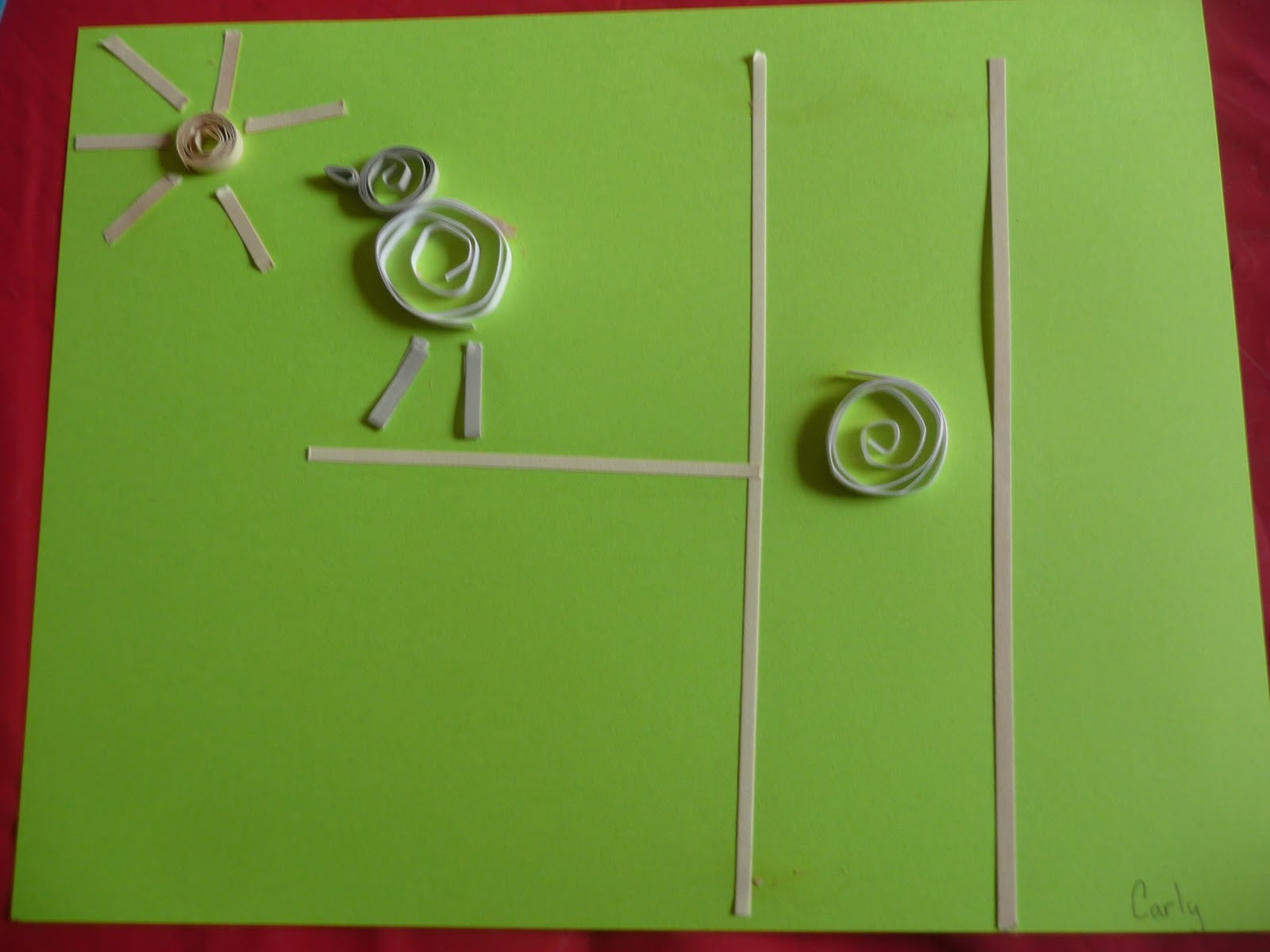
In our history coop, we do an art for each area and period we study.  We've been studying Regency England, and it was my turn to do the art.  So the art that I selected--one that is mentioned in books by Jane Austen and other writing during that time--was quilling (also known as paper filigree).

Quilling is a design out of rolls of paper, created by rolling thin strips of paper around a feather quill.  It was used to decorate cards, scrapbook pages, or picture frames.  It was traditional made up of either simply decorative scrolls, or to depicts items from nature, such as flowers or animals or insects.

I created the following picture as a quasi-traditional picture of Regency quilling:


But the students took it in new and creative directions.  We had two abstracts/ornamentals:


(This looks rather Fibonacci-like to me, which reminds me of my beloved book, Blockhead)

One flora:

Several birds, each beautiful and unique:


And then, one squid:


It is a fun, pretty easy, and less familiar craft, and I think it is a great addition to a unit on Regency England.

Saturday, January 29, 2011

Picture Books for Middle Schoolers

As long as I am on my "don't abandon all youthful tools" kick...

Pragmatic Mom had a thought-provoking blog post where she asked people to help compile a Top 10 list of Caldecott Medal and Honor Books.  It was tough, but I finally came up with this list based on my self-imposed rules:
--No more than one book from any one author
--Selection was more than just that one book, but also considered body of work by that author

Going in order from oldest to newest, my top 10 choices were:

Bartholomew and the Oobleck by Dr. Seuss, pseud. [Theodor Seuss Geisel]

The Snowy Day by Ezra Jack Keats
Where the Wild Things Are by Maurice Sendak
Anansi the Spider: A Tale from the Ashanti , adapted and illustrated by Gerald McDermott
The Polar Express by Chris Van Allsburg
Tuesday by David Wiesner
Seven Blind Mice by Ed Young
In the Small, Small Pond by Denise Fleming 

What Do You Do with a Tail Like This? illustrated and written by Steve Jenkins and Robin Page

Zen Shorts illustrated and written by Jon J. Muth

And while some might think that Caldecott winners were too young for middle schoolers, I would disagree. For example, we still create Oobleck, sometime for science, sometimes just for the fun of it. I used Tuesday in a writing class (for a lesson of "show, not tell" in writing) and Seven Blind Mice in a religion class (as a metaphor for trying to explain the divine). I anticipate using Anansi the Spider when we get into Jung, and Zen Shorts when we get to Buddhism. And, of course, we once again celebrated the Christmas season with our annual reading of The Polar Express.

But it got me to thinking that maybe I would create my own Top 10 list of Non-Fiction Picture Books for Middle Schoolers, based on the resources I have been using in my classes for this academic year. So here are the Picture Books that have figured most prominently in our 6th Grade lessons so far:


Math (but really, so much more)
Blockhead:  The Life of Fibonacci by Joseph D'Agnese  I wrote an entire post about this book, which we love, love, LOVE.  We used it not only for math, but for history, art, and even literature, since it has inspired us writing some short poems known as Fibs.


History (we are studying 19th Century World and American history)


History and Science  
The Cod’s Tale by Mark Kurlansky

Science
The New Way Things Work by David Macaulay
The Way We Work by David Macaulay
These aren't really classic Picture Books, so I'm counting them both together as one book.  But they both present scientific information in such a great visual way, and work either reading sequentially through the book, or just picking up a page or two at a time to get clear about a particular question that has come up about a tool or a body part.

World Religions (so far, just Judaism and Christianity)
Creation by Gerald McDermott
Exodus by Brian Wildsmith (my review of this book)
Spirit Child:  A Story of the Nativity by John Bierhorst

I also found a couple of resources with some other good Picture Books for middle schoolers.  One is from another blog of a book-loving teacher, Planetesme, where she lists some other top notch picture book biographies.  An even more thorough and academic-oriented resource is A Middle School Teacher's Guide for Selecting Picture Books.
But I would love to get any suggestions that you have for picture books for students in the 11-14 age range.  Anyone have any other picture books to recommend to us?  Please share them in the comments below.

Friday, January 21, 2011

Book Review: Heart of a Samurai by Margi Preus

Heart of a Samurai by Margi Preus is another of the Newbery Honor winners for 2011.   This is a book that my son read, and deemed pretty good, but it never had much attention among his Newbery Club (nor the others I checked online), so I hadn't read it.  But that was my loss.  After it was honored by the Newbery Committee, I read it and found it to be quite a wonderful book.  I still, personally, prefer the books that were on my final list, but I enjoyed it a lot and could at least see why it might have won a Newbery Honor, which is still more than I can say for Dark Emperor (good book, but not exception to my point of view).

Heart of a Samurai is the fictionalized account of a real event; a 14 year-old Japanese boy named Manjiro who was stranded with his friends on a deserted island in 1841 and then picked up by an American whaling vessel.  Japan maintained a very isolationist policy then, so all outsiders were considered "barbarians"; nonetheless, Manjiro comes to appreciate his barbarian saviors, especially the compassionate Captain Whitfield, and eventually agrees to his offer to see the world beyond what the Japanese people had ever imagined.

The book contains a lot of historical truth, including incorporating Manjiro's drawings of his adventures (although attributed to his American name of John Mung).  It's the kind of book that I think make great Newbery candidates; it puts the reader inside the head of a character that is probably QUITE unlike them, preferably at a time or in a culture that is so different that they can't imagine it.  So it is a great area of growth as this secluded Japanese boy encounters the whole huge world that has been denied to him by his government's policy.  However, along with the wonderful things he sees, he must also deal with prejudice from Westerners who have never seen Japanese and who believe them to be equally "barbarian."

In the end, Manjiro/Mung wrestles with that most middle school of questions--Who am I?  Where do I belong?  I don't seem to fit in with American culture--but will I fit in with Japanese culture?  His pathway through life, as he explores those questions, is not completely predictable, but is especially compelling because it is (mostly) a true story.

So this is an excellent book on many levels...not just the reading and the illustrations, but also on a psychological level as well as a tale of the 19th century interactions between the US and Japan.  As I said, it didn't supplant any of my top choices, but I can certainly embrace it as a Newbery award-worth book.

And how lucky for us that we happen to be studying 19th century history this year!