Showing posts with label Christianity. Show all posts

Tuesday, April 10, 2012

Lesson Plan: Pysanky-inspired Easter Eggs

Before we completely abandon the Easter theme--


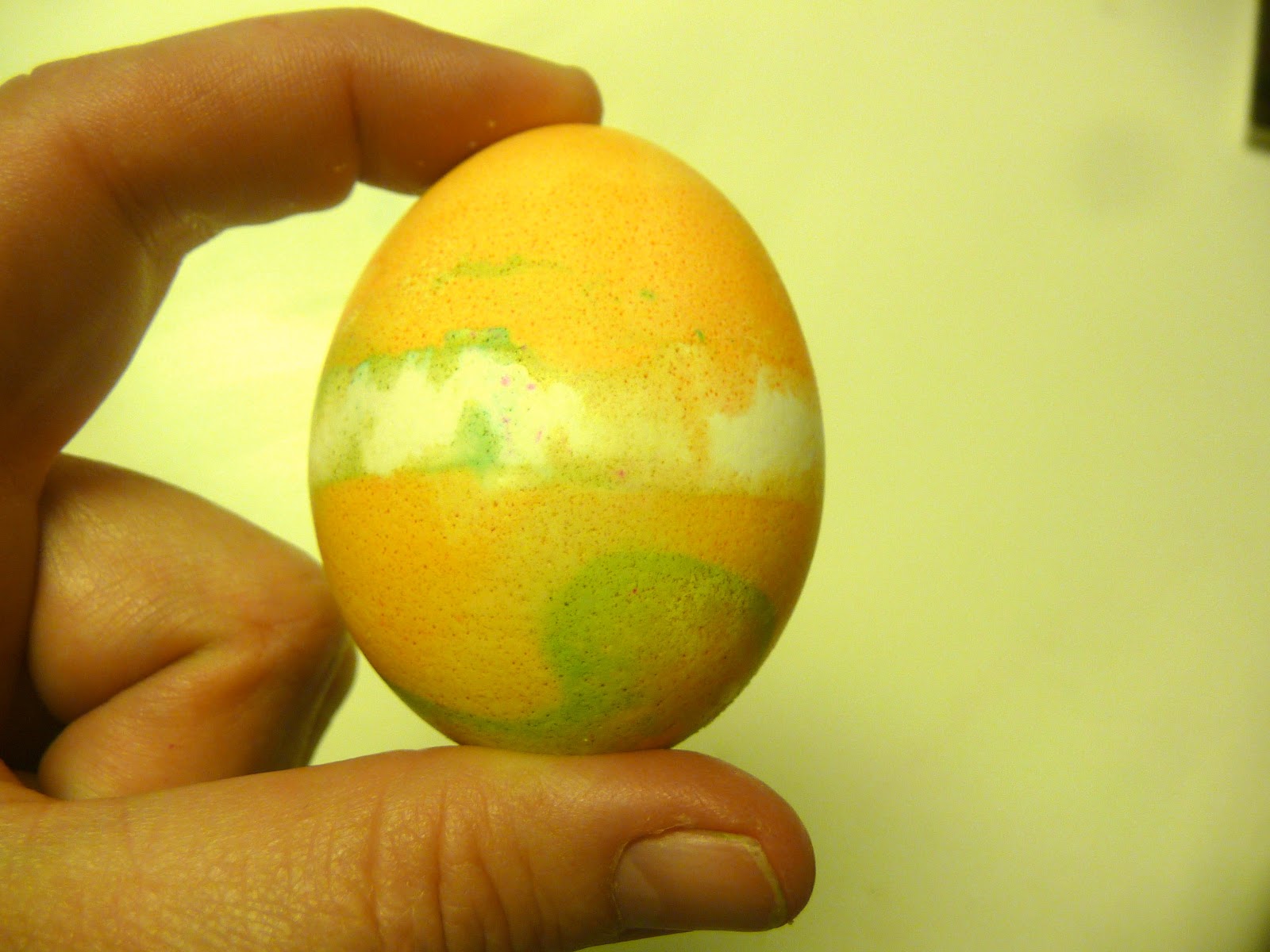
Last week in our World Religion class, we made eggs inspired by the Ukrainian technique of decorating eggs called Pysanky.  The traditional art of Pysanky is kind of like batik on eggs; that is, the artists uses wax to over up the parts of the egg they want to keep the existing color, then dip the eggs into increasingly dark dyes.  So, for example, they first cover up what they want to remain white, then dip the egg into yellow dye.  Next they apply more wax to the areas they want to keep yellow (without removing the wax on the white areas), and then dip the egg in the next darkest color (usually orange or light pink).  This continues until the eggs have been dyed their darkest colors, usually dark blue, purple, or black.  After they have dried completely, the artist uses heat to remove the wax, revealing the multi-colored designs the wax have protected over multiple dying cycles.  They can end up being really fabulous.

Obviously, this is a long and involved process that doesn't fit well into a limited class time.  So we kind of faked our way through it by using masking tape instead of wax.  We couldn't get the fine lines of true Pysanky, and with the number of people we had and our time constraints, the students couldn't dip them in too many colors.  But it did give them the idea of how it worked so they could explore it more at home.

But more than simply a craft activity, we also discussed things related to Easter as we dyed our eggs.  For example, I asked them what the life and/or death of Jesus had to do with eggs.  They came up with lots of creative ideas, but then I let them know the answer--nothing, really.  Dying Easter eggs, such as Pysanky, is a hold-over tradition from pagan times.  In the case of the Ukranians, for example, eggs became sacred symbols and talismans because the ancient people worshiped birds because they could fly up to speak with the Sun God, which was their highest diety.  So decorating eggs became part of their spring solstice celebration known in English as Ostara (which is where the word Easter came from).  Because in these celebrations, the eggs were used as a symbol for spring and the rebirth of the Earth, when the Christians came along, they allowed the pagans to continue their old traditions, but just tried to convince them that the rebirth was not of the Earth, but of Jesus.   It was techniques like these--assimilating pre-existing rituals rather than trying to eradicate them--that helped Christianity spread through so many different cultures to become the largest religion in the world today.

However, I also encouraged the student to think of the multiple dying cycles as representing the many different types of trials that Jesus went through during Holy Week, or the last week of his normal human life on Earth.  That is, obviously the focus is on his physical death by crucifiction.  But also during that week, he had to suffer doubts and abandonment (his friends fell asleep during his final hours of freedom), betrayal and denial by his disciples, false claims and judgements by both religious and political authorities,   rejection by the masses who had acclaimed his entrance into Jeruselum only days before, physical torture, and attempts to mock and humiliate him.  His ability to retain his faith and his dignity, and even to forgive those who participated in all these trials, are inspiring lessons in themselves, regardless of what religious beliefs you have about truth and/or meaning of the crucifixion and resurrection.

Anyway, we had a good discussion and created some pretty eggs, even in our rushed and limited situation.  Here are some of the eggs we made:


Sunday, April 8, 2012

Spring and Gratitude

Today is Easter in North Carolina, so Happy Easter for those who celebrate this day!  Of course, the Jewish holiday of Passover has just occurred, so a belated Happy Passover to those readers.  And it wasn't too long ago that the Pagan holiday of Ostara took place, so good thoughts towards any of you who might be Wiccan or other variations of Paganism.  And there are probably some Spring celebrations in Islam, Hinduism, and Buddhism that I just don't know about; if so, happy thoughts in your direction as well.

I'm sure that it is no coincidence that so many of these religious celebrations take place in Spring.  You don't have to follow any religious practice at all to be uplifted and inspired by the rebirth that takes place in Nature at this time of the year.  I'm noting that even though our past winter was so mild that it seems like turning into Spring wouldn't be that big of a deal, but the flowers and such seem even more intense this year, as if knowing they had to put on an extra special show in order to show off the contrast between the seasons in a year of temperate temperatures.

There are two non-religious Spring-related occasions that we particularly celebrate in our household, or at least we have for the past few years.  One is the opening of our local Farmers' Market in Cary.  While we do have access to fresh vegetables all year round at other Farmers' Markets in the area, the Cary market is shut down from December through March.  So by the time the first Saturday in April rolls around, I can't wait to see all my farmer friends and start buying fresh, local produce again directly from the producers.  And this year was extra special because, after a hiatus of a couple of years, the Cary Farmers' Market has once again move to downtown Cary, and is in even closer walking distance from my house than it was previously!  That means a lot to me in my ongoing efforts to reduce our family's carbon footprint.

Another event of great note in our home is the first fresh local strawberries of the year.  Every since reading Michael Pollan's The Omnivore's Dilemma (yes, that book AGAIN, for my regular readers....what can I say, it changed my life), I no longer buy fresh strawberries except locally during our relatively short growing season in North Carolina (read the book to find out why).  But I seriously love strawberries, so it is a big deal when they return to our diet, albiet for only a few, short, precious weeks.   So only buying local strawberries in season has really raised my appreciation for this wonderful fruit that is gone all too soon.

But this year, for the first time since I've been shopping at the Farmers' Market, Market Opening Day and First Strawberry Day coincided!  Apparently the mild winter has coaxed the local strawberries into blooming early.  So, joy of joy, I bought a mess of them, and they will be part of our Easter celebration at our spiritual center (we are having an egg hunt for the children, but the eggs will contain fruit instead of candy) and our Easter dinner table.  But I have already welcomed the strawberries by opening a bottle of champagne with a friend and drinking the sparkling wine with our first strawberries in the glass as well.

So pick what inspires you--your religious or spiritual tradition, Nature's beauty, the longer days, the warmer weather, or the return of the seasonal crops.  Spring is great time to be thankful for all the wonderful things that this planet continues to provide us, despite our often not-too-great stewardship of its resources.

I'll end with a lovely video on Nature and gratitude that my friend Lorna shared with me.  I hope you find it as inspiring as I did.


Enjoy!

Saturday, March 17, 2012

Lesson Plan: Celtic Christian Prayers

Happy Saint Patrick's Day!  I hope the Leprechauns were kind to you.  They visit us every year, but didn't cause too much mayhen this time...  And my son and I did a great Green activity, which was to visit the beautiful gardens at the Arboretum at NC State, where all the flowering trees are blooming beautifully, before coming home to our new tradition of eating Bangers and Mash for St. Patrick's Day Dinner.

But last week in our World Religion class, where we have just started studying Christianity, we prepared for Saint Patrick's Day by studying Celtic Christian Prayers.  Ireland is an interesting place in terms of Christianity because it retained its Pagan religion longer than many other places that are now Christian, and I believe the Irish Christianity has more of an Earth-based-religious flavor than many other strands of Christianity.

For this lesson, I gave the students several pages of Celtic Chrisian Prayers (there are also current Celtic Prayers that are more Pagan, but the ones we used were all directed to the Christian concept of one God, along with Jesus as his special Son/Helper/Teacher).  We read them and then the students journaled about what they had in common and/or what seemed different to them from traditional Christian prayers they knew.  The list we came up with were:

1.  A concentration on concrete, rather than abstract, things or themes
2.  A focus on everyday life and/or common items
3.  More emphasis on gratitude for simple things than asking for "miracles" or personal goals
4.  Much attention to natural items

After that, I had the students write their own prayers or blessings, as influenced by Celtic Christian prayer philosophy.  As always, what they came up with was very different, but very beautiful.  Here are some examples:

May the rain nourish the plants
May the plants nourish the people
May the people nourish the Earth,
Let the earth provide for its providers.


May friends assist and bless you
And may beds aspire to rest you
And may you live under a roof
And may some dogs always woof
And may you earn substantial dough
And may you wear a wig Afro
And may your soup always taste good
And may your forest always have wood
And other stuff to be taken care
And may you have a rhyming prayer.


Let God be upon you when you are going through hard times.
Let God help you through your struggles and let him help you get out of the struggle.


May the sky always be blue
May the grass always be green
May the Earth always be saved
And may the people always want to save it.


To wake up looking at the trees
With the birds' songs in the air,
To break the fast
With healthy, nourishing food,
To fill the day
With creative, productive work,
To end the day
With loving family and good friends,
And to look forward to the next day filled with the same,
For this, God, I thank you.

They were all lovely and heartfelt reflections of the personality of each student, and I really appreciated each one.  So it was one of the best Saint Patrick's-related activities that I have ever done, as well as I great way to look at a different Christian tradition than most may be exposed to, at least here in North Carolina.

Tuesday, September 20, 2011

Lesson Plan: World Religion Dream Catchers

In my short (five-week) World Religion class, we are concentrating on the six religions that have had the most influence on Western culture--Paganism, Hinduism, Judaism, Buddhism, Christianity, and Islam (in order of when they began).   So to help the students keep the order of these religious movements straight, we made World Religion Dream Catchers.

Dream Catchers are a tradition among some Native American tribes (which fall under the Paganism category).  They are a circle created out of a branch of wood, between which string and beads have been strung, creating an open web in the middle.  The idea is that the dream catcher will capture the bad dreams sent to a child, but will allow the good ones through its openings.

Because we are on a restricted budget of both money and time, we made ours out of paper plates, from which I had cut out the centers and punched eight holes around the inner circle of the remaining rim.  I had the students write the names or draw symbols for the six religions (we covered the religious in symbols in class beforehand) on the paper plate rims, and then string yarn from hole to hole IN ORDER of the religion's founding date.  So the first hole was just the start, but then the student would string the yarn through the Paganism hole, then through the Hinduism hole, then Judaism....you get the idea.

Here are some samples of their work.  As always, they were following the same instructions, but came up with some lovely variations.


Sunday, March 6, 2011

Lesson Plan: The Jesus Feast

We have come to the end of our three month study of Christianity, and we thought we would cap things off by cooking a meal for our spiritual center that we called "The Jesus Feast."  Because we spent much of the time learning about the times, place, and culture in which Jesus lived, we thought a great way to showcase what we had learned was to fix a meal featuring the food that was typical of that time in what is now Israel.

When I first proposed this idea, I thought we would have kind of a targeted pot luck type lunch with food from that period.  However, I'm blessed to have a wonderful friend, Miss Nika, who used to own her own restaurant and catering business.  She is, needless to say, a fabulous cook, and she is also so great at working with our middle school kids.  She really got into researching the foods of the time with the students, and ended up preparing a repast that had the entire spiritual center in awe of what the middle school class had created.


Because we have a lot of different eating preferences among our group, we ended up with three different menus:  one for vegans, one for vegetarians, and one for omnivores.  The vegan options included:

  • lentils
  • barley
  • bulgar
  • stuffed grape leaves
  • cucumber salad
  • mixed olives
  • fresh and dried fruit and nuts
  • homemade hummus and freshly grilled pita bread
For the vegetarians, we added:

  • cucumber in yogurt and dill
  • hard boiled eggs
  • salad with feta cheese
Omnivores could also have:

  • roasted chicken
  • chicken garbanzo stew
So we ended up with a main serving table looking like this:


With an additional meat/hot foods table that we had an adult handle:


AND, of course, a dessert table:


That is a vegan (no eggs, dairy, or honey) cake on the left, a vegetarian honey cake on the right, with some yogurt and honey in the middle.  Also on the table were grape leaves, sweetened and plain almonds, dates covered with coconut, and dried apricots with pomegranate seeds in the middle.

So, truly, a good time and a good meal was had by all.  Plus, I think the students learned a lot, not only about the foods from the times of Jesus, but about working together as a team to feed about 50 people in a healthy and expeditious way.

Sunday, February 6, 2011

Lesson Plan: Miracles of Jesus About Food (Wedding at Cana, Disciples Catching Fish, Feeding the Multitudes)

Last week in our World Religion class, where we are currently studying Christianity, I did a lesson about the miracles Jesus did that involved food.  I started with the Wedding at Cana, which was the first miracle reported in the Gospel of John.  With all three of these miracles, I simply told the story, rather than reading it out of the Bible or a written rendition.

For the Wedding at Cana, I had made some preparations beforehand.  I had a glass pitcher of water and a tray with enough plastic cups for all the students.  However, before class, I had put a tablespoon of red Kool Aid in each cup.  So as I told the climax of the story, I poured the visibly clear water into the cups where-Voila!-they turned into red liquid.  While a younger audience might be fooled by this, the middle schoolers figured it out, and started shouting out I had stuff in the class and that it was Kool Aid instead of wine, etc.  But I never said a thing.  I neither confirmed nor denied their accusations, and, of course, I never said that I was performing a "miracle."  However, when we were reviewing last week's lesson, they all remembered the red drinks and the water into wine story--which, of course, was my real goal for doing it.

The next story I told was when Jesus told Simon/Peter and Andrew to cast their nets into the water, even though they had been fishing all night and had caught nothing.  When they did as he said, their nets were filled with fish, causing Simon (whom Jesus called Peter) to be the first disciple to acknowledge Jesus as the Messiah that had been promised in the Jewish Torah.  Once again, I prepared something before class.  I took a large white piece of paper and drew a rough fishing net on it with permanent ink (I used a Sharpie pen).  In between the...well, they weren't squares...looks like maybe they were trapezoids (thank you, Google!)....anyway, in the white space in the net, I took a white crayon and drew fish shapes.  I had to press down fairly heavily to leave enough crayon, but you still couldn't see it against the white paper.  Then when I was in class, when I got to the part that Simon cast his nets in the water and they filled with fish, I took some dark blue water color paint and painted over the nets.  TAAA  DAAA--the invisible fish suddenly showed up!  They thought that was really cool, and couldn't figure that one out as easily.  Once again, when asked about it the next week, the students could tell the story.

The last one was less "magical," but may have been appreciated most of all.  As I talked about the two stories, one about feeding 4,000 families and one about feeding 5,000, both times with just a few loaves of bread and a few fishes, I took an unsliced loaf of bread I had bought and tore it into pieces, put it into a basket, and passed it around.  I also had a bag of Swedish fish candies, which I put into another basket, and passed it around.  So they had a ghastly meal of Kool Aid, Sourdough Bread (albeit high-quality, natural, and without preservatives), and Swedish fish candies--most of which I would NEVER serve my son at home.  But, of course, it was a HUGE hit.

It's one of those rules of thumbs, really with most children, I think, but definitely with middle schoolers--if you want them to love your lessons, give them some food.  But it was educationally justifiable in this case!  And, as I said, they seemed to have a much higher recall then they have had with some of my other lessons.  What can I say...food works.

Monday, January 24, 2011

Lesson Plan: Twelve Disciples Diviner (World Religion-Christianity)

In the World Religions class for Middle Schoolers that I am doing, where we are currently studying Christianity, this week it was time to cover the Twelve Disciples of Jesus.  I was trying to think of a fun way for them to remember all twelve names, when suddenly I thought of those old "fortune tellers" we used to fold when I was about that age.  Those things have twelve flaps--PERFECT for a project I called "The Twelve Disciples Diviner."

Here are the instructions, interspersed with some pictures I took of the one I made (for you visual learners...although presenting in multiple modalities really helps us all):


First, fold two opposite corners of the paper together (so that the paper is folded in half and is the shape of a triangle) and then open them up again.  Take the other two opposite corners and fold them together (again, folding the paper in half in the shape of a triangle) and then open them up again.  You should have a square piece of paper with two folds that make an X in the center of the page.


Next, fold all four corners to that center X so that they meet in the center and form the paper into a smaller square.


Now flip the paper over, so that you are looking at a square piece of paper with no down-folded flaps showing, but with a folded X in the middle.  Fold each one of those corners down to meet the X, so that they all meet in the center and make an even smaller square.  This time, however, each of the four corners flaps meeting in the center will have two separate triangular sections (for a total of 8 triangular segments).


Write one of the following names on each separate triangular segment:
  • Philip (Greek)
  • Bartholomew
  • Matthew (tax collector)
  • Thomas (doubting)
  • James, son of Alphaeus (the lesser)
  • Thaddeus
  • Simon the Zealot
  • Judas Iscariot


Then open the four corner flaps, and behind each triangular section, write a different quality of God of their choice (for example, peace, joy, abundance, forgiveness, patience, etc.).  Once that is done, fold the flaps down again and recrease the folds.


Flip the square over again so that you can see four square corners meeting in the middle.  On each one of those squares, write one of the following names:
  • Simon, called Peter (son of John)
  • Andrew, brother of Peter
  • James, son of Zebedee
  • John, brother of James
Also draw a small picture of a fish on each one of those squares.


To use the divener, insert the thumb and the forefinger of the right hand under the two flaps on the right side, and the thumb and forefinger of the left hand under the two flaps on the left hand and push the four corners to meet in the center.  To operate the diviner, think of a question or situation that calls for some quality of God or spirit.  Then chose one of the four names on the outer four flaps, and open and shut the diviner in opposite directions according to the number of letters in that name (so, for example, 5 times for the name Peter).  Select one of the name exposed by the 5th opening, and then open and shut the diviner again by the number of letters in that name (so, 6 times for Thomas).  Then choose one of the names shown, and read the God/spiritual quality under that name.  That is the God/spiritual quality that should be used to resolve that situation or question.